Documenting the evidence and the policy case for fair, transparent, merit-based veterinary licensure.
These pages are designed to answer the exact questions people search when they are trying to understand the veterinary shortage, ICVA, NAVLE, AVMA COE, NAVLE audit concerns, and the LMU lawsuit.
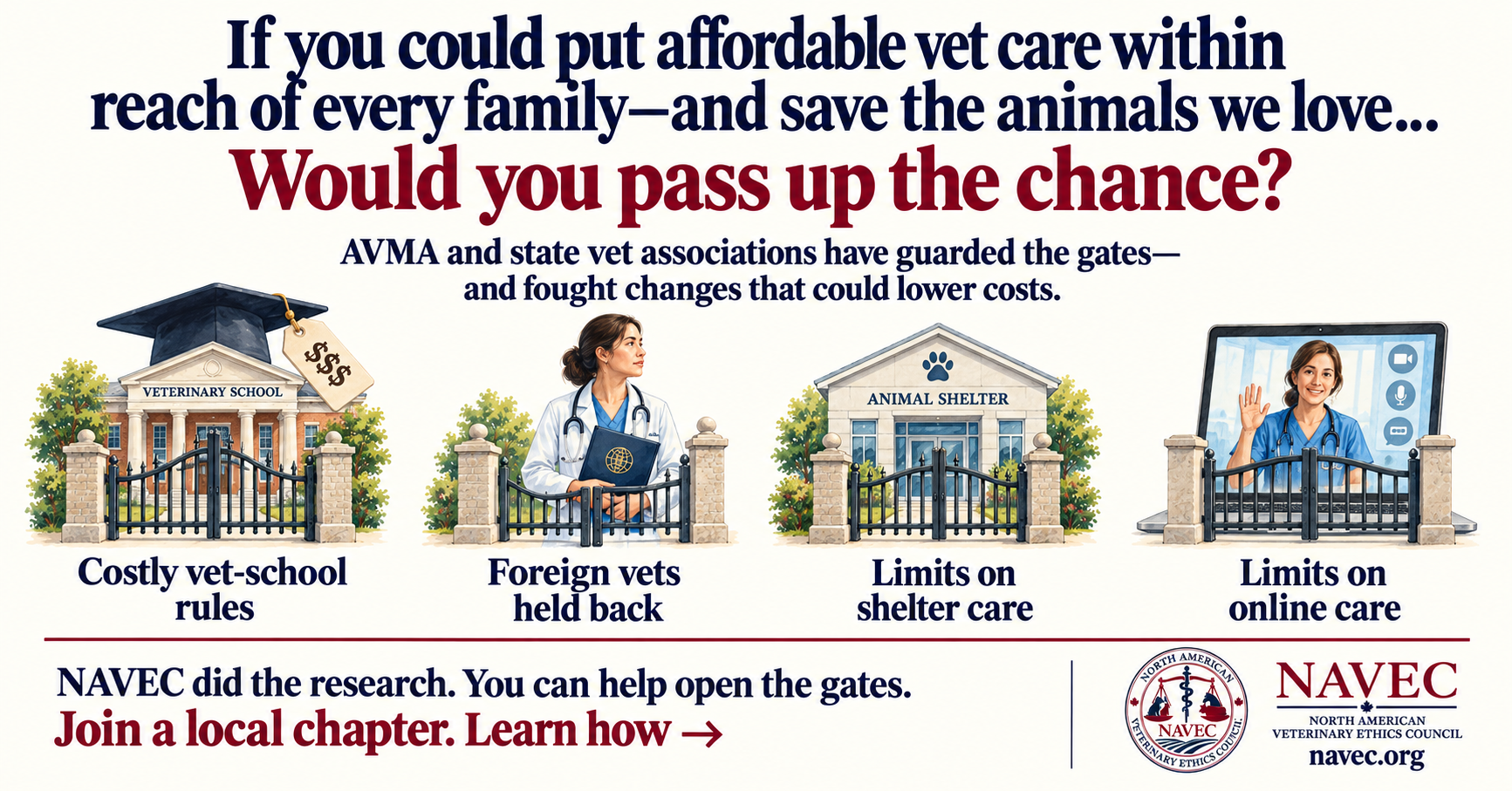
Help change the rules keeping vet care out of reach. See how one woman got her state board to act, and how a NAVEC chapter can help you take the next step.
Find your role →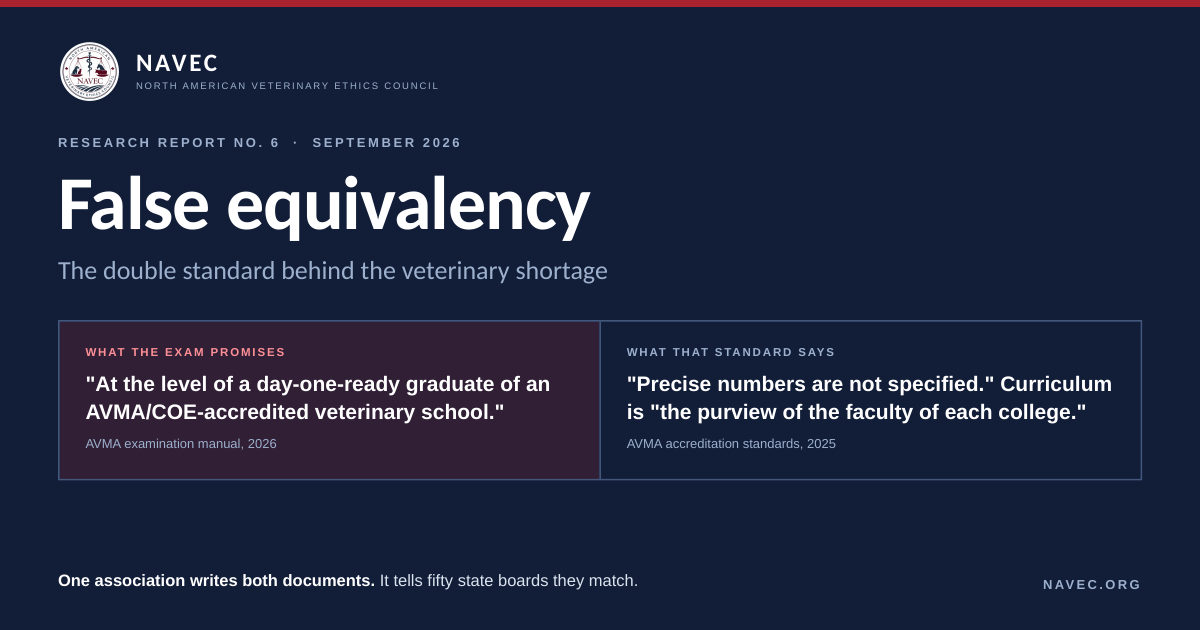
Thousands of trained veterinarians are in this country and cannot work. To be licensed they must pass a $12,804 examination that one private association promises will measure them against a new American graduate. That association also writes the rules for American veterinary schools. Set the two documents side by side and they do not match, and its own bulletin admits the exam covers only “a subset.”
Read →
AVMA accreditation makes a research-heavy, capital-intensive school model the minimum. For a student who must move, the public-resident 4+4 route can leave about $315,000 to finance—more than the student may borrow federally. NAVEC shows a self-funding five-year path that opens the profession to qualified students from working and middle-income families without lowering standards.
Read →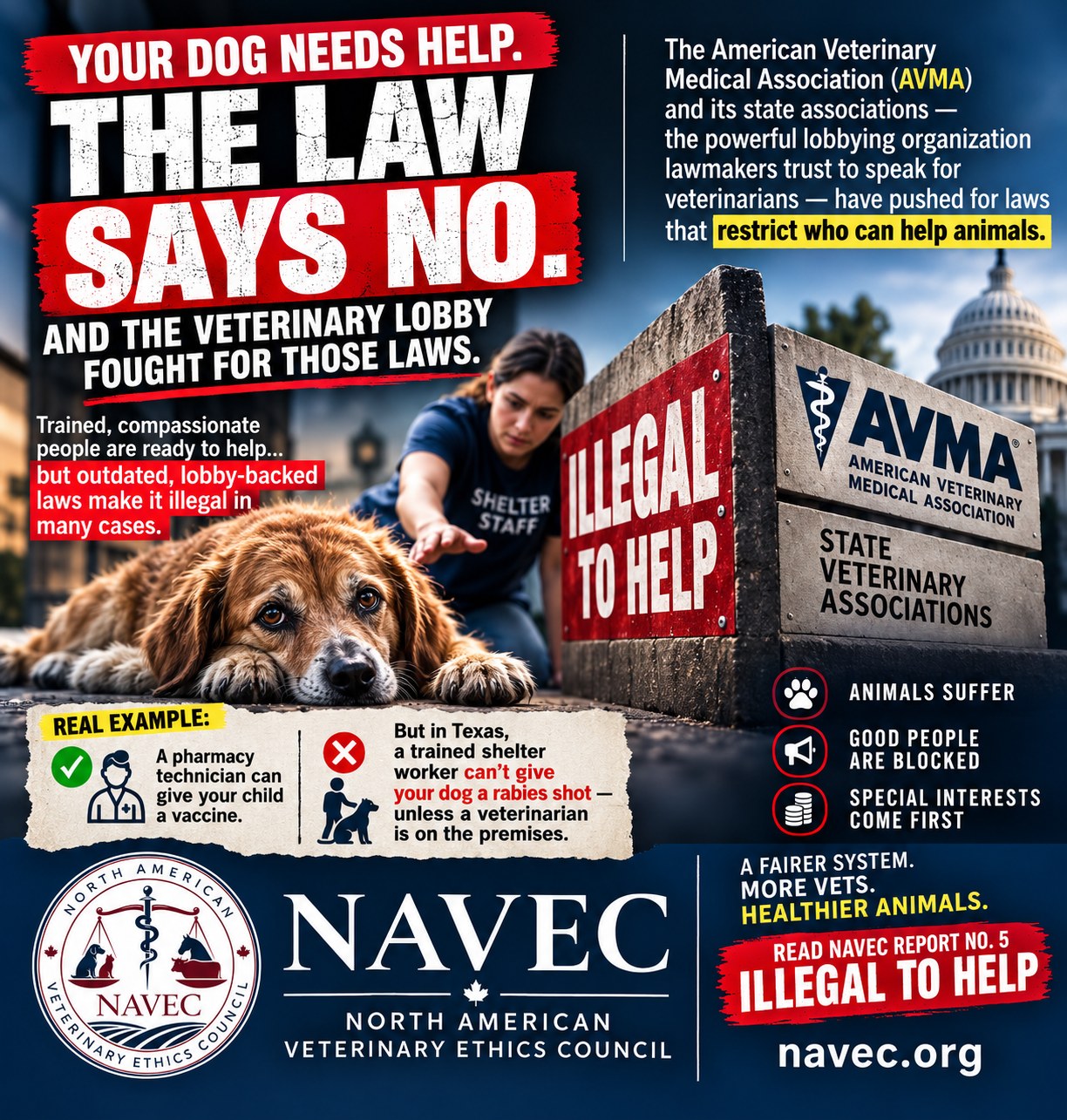
No vet for miles. Bills that make your chest hurt. A shelter that wants to help but legally can’t. None of it happened by accident. The plain-English story of the club that wrote the rules, and what one person can do about it. Read it, then share it with someone who loves an animal.
Read →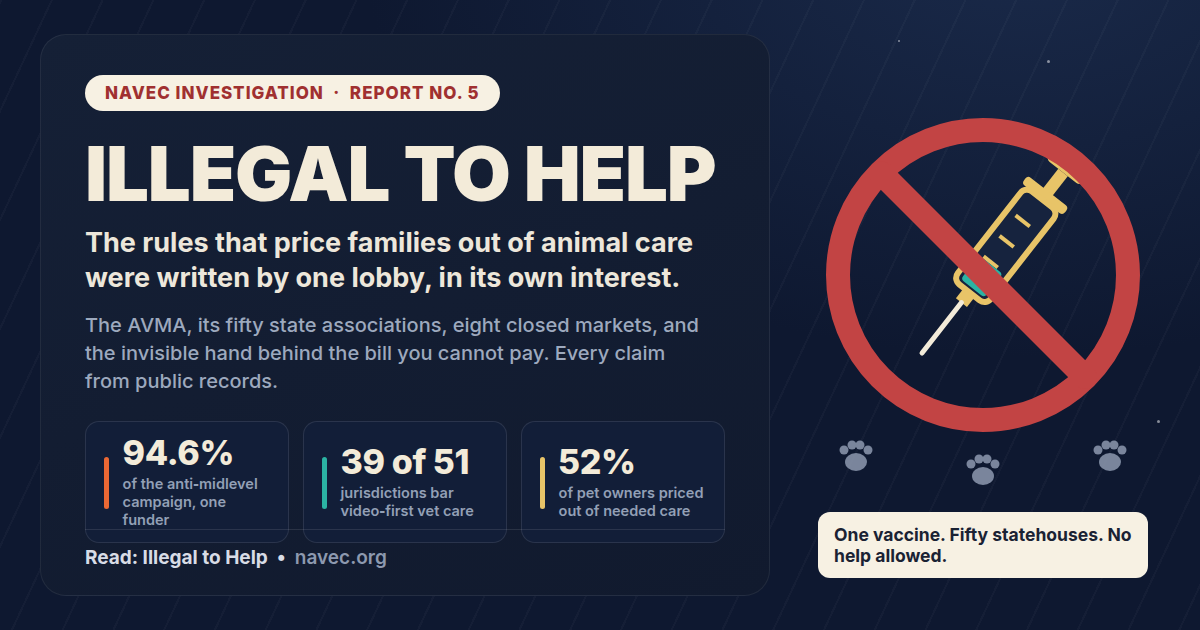
A pharmacy technician can give your child a flu shot in all fifty states. In Texas, a trained shelter worker who gives your dog a rabies shot is breaking the law unless a veterinarian stands on the premises. NAVEC Report No. 5 documents the lobby that writes rules like that: eight closed markets, one campaign wallet, and the families, animals, and independent clinics that pay. 63 pages, 205 sources.
Read →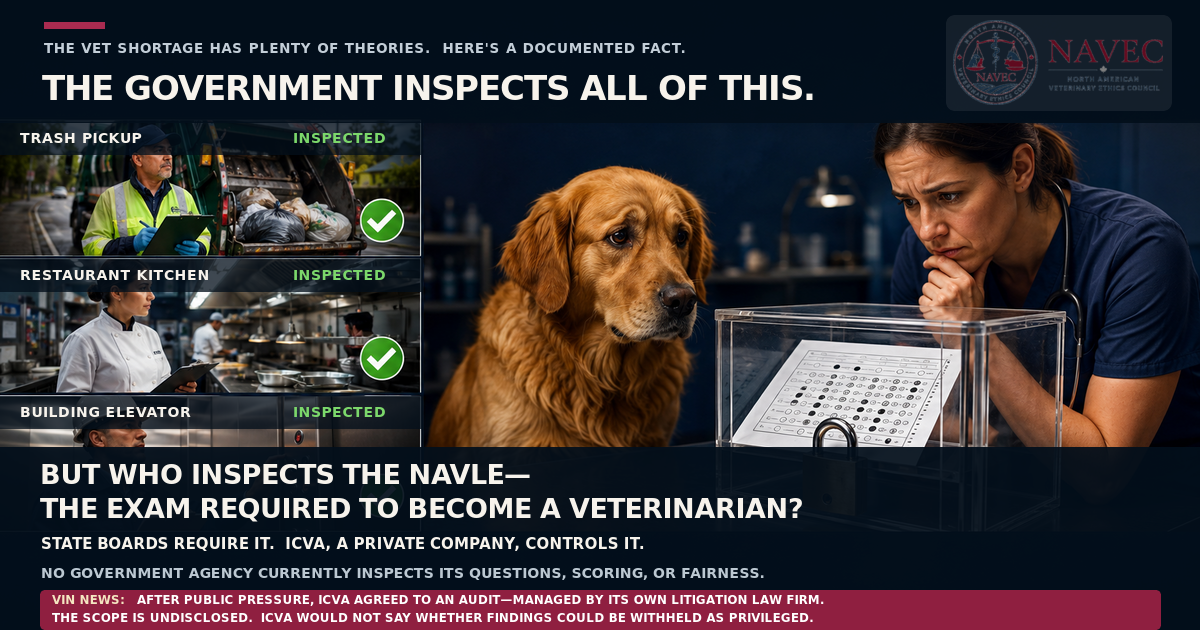
VIN News examines the private company that owns the exam every veterinarian must pass: never independently audited, an audit run by its own law firm with no stated scope, and a candidate agreement that allows score cancellation with no requirement of proof. Our plain-English guide, with every claim linked to its source.
Read →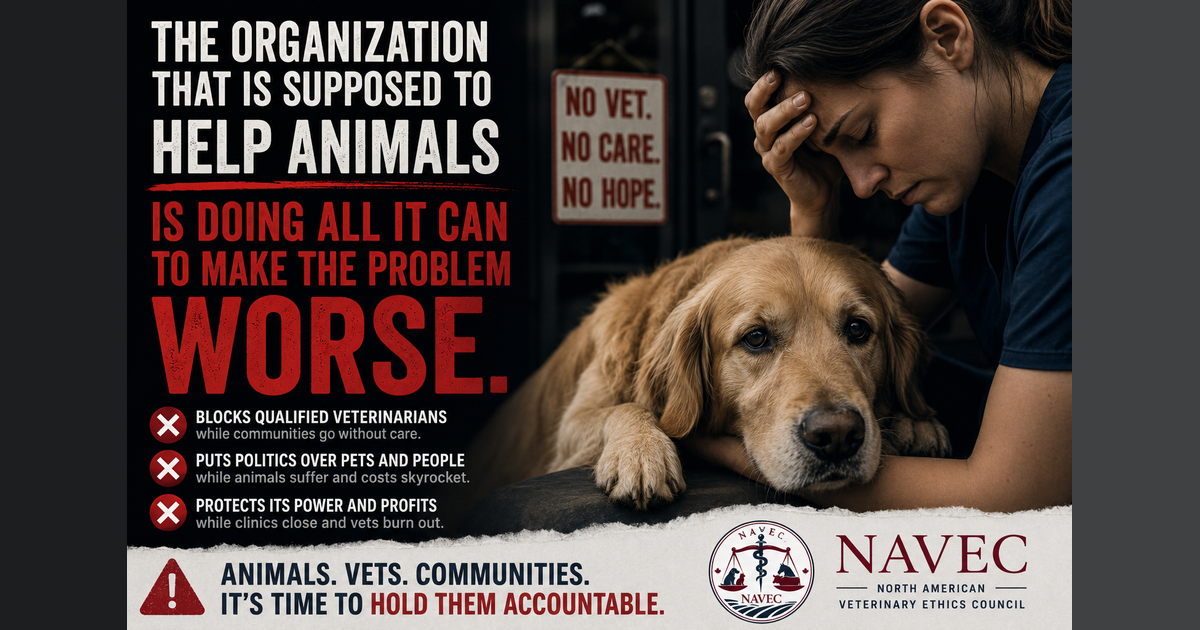
America is short 37,000 vets — yet thousands of trained veterinarians, many of them U.S. citizens, wait years at a gate owned by the AVMA itself: 256 first-time exam seats a year, a 75% failure rate, fees doubled, and no auditor allowed. The full report, with charts and case files.
Read →
For fifty years, AVMA-commissioned studies forecast a veterinary surplus — and for twenty of those years, not one new U.S. veterinary school was accredited. NAVEC Head of Research Edward Timmons, PhD, traces how the shortage was planned.
Read →
A summary deck, two white papers, and an open call set out a complete, costed plan for an independent licensing examination and credentials commission, governed by the state boards themselves — launch fee $450–495 against today’s $825, nine to twelve months to first administrations.
Read →
Six-figure bonuses, closed clinics, and rural care deserts point to a deeper problem: AVMA and ICVA supply gates that control who can enter veterinary medicine.
Read →A plain-English guide to AVMA/COE, ICVA/NAVLE, high vet bills, foreign-trained veterinarians, rural care deserts, and medical-model reform.
Open guide →America has too few veterinarians — in some counties, none at all. Yet for fifty years one organization has forecast a surplus while holding the lock on the gate into the profession — an arrangement the Justice Department has now told a federal court is not above the antitrust laws.
Read →607,000 shelter animals were euthanized in 2024 while shelter and nonprofit veterinary jobs sit empty. The shortage isn’t an abstraction — it’s measured in lives, and it’s solvable.
Read →They trained at accredited schools and passed the exam-maker’s own official practice test — then failed a licensing exam whose scoring no one outside the exam-maker can inspect or independently verify. At the only historically Black veterinary college, the pass rate fell from nine in ten to barely half in six years. A new NAVEC report assembles what the public record shows.
Read →Accreditation lets veterinary schools teach differently, yet the NAVLE tests every graduate the same — on a blueprint written partly by faculty from those same schools. When the only historically Black veterinary college’s pass rate fell from nine in ten to barely half, no public data could explain why.
Read →A private monopoly controls the one exam that decides who may practice veterinary medicine. When critics said it was unfair, it didn't open the books — it changed the rules and called the result an audit.
Read →The official forecast promises a surplus by 2030. Rebuild the math from the animals up — who actually needs care, and who's actually left to provide it — and a deep, widening shortage appears instead. With the full report.
Read →The power to decide who can train, test, and practice as a veterinarian has been handed to private organizations that answer to no one. That's the root of the shortage.
Read →Farm country is losing its veterinarians. The cause isn't a lack of people who want the job; it's a system designed to keep their numbers low.
Read →A single trade association controls both who graduates from a U.S. veterinary school and who enters from abroad. No other major profession concentrates that much power in one private body.
Read →The shortage was built by policy choices. It can be unbuilt the same way — and human medicine already shows how.
Read →Veterinary ethics usually means how a vet treats your animal. But the deepest ethical failure in the profession is structural: a system that keeps good veterinarians out.
Read →Small farmers can do real things today to manage veterinary costs — and there's a structural reason those costs keep climbing.
Read →NAVEC exists to bring competition, transparency, and public oversight to a profession whose gates are held by two private organizations. Here's the case, and the campaign.
Read →