NAVEC has published complete construction blueprints for an independent veterinary credentialing system — a national licensing examination governed by the state boards themselves, and an independent credentials commission for foreign-trained graduates. Designed, costed, and scheduled. Ready for founders.
One examination stands between every veterinary graduate and a license to practice, in every U.S. state and Canadian province — and no licensing board can independently verify that the examination it requires is fair, accurately scored, or properly maintained. The International Council for Veterinary Assessment (ICVA) publishes limited technical materials; what boards do not receive is peer-level public documentation, independent scoring audits, or any verification mechanism sufficient for mandatory reliance. Nursing, medicine, pharmacy, and law are all governed differently — with the regulators inside the room.
These blueprints answer a structural problem structurally: not by asking the incumbent to change, but by designing the alternative completely — governance, budget, fees, item development, security, adoption law, and continuity — and letting the boards choose. If the incumbents reform to the same standard first, that is success too.
The whole argument in twenty slides: the verification gap, both institutions, governance, budget, the fee schedule, three adoption pathways, and the public record behind it all.
Open the deck →The Examination Council: an eleven-seat board under a Delegate Assembly of state regulators on the nursing model; a 300-item, standards-built examination; transparency obligations written into bylaws; a published fee schedule; and the construction plan.
Read the paper →The Credentials Commission: the model human medicine has used since 1956, adapted to veterinary licensure — primary-source verification, distributed clinical-competence routes, and all-in candidate costs of $2,000–3,500 (est.).
Read the paper →The plain-language invitation to state boards, universities, funders, and the profession: what to build, what it costs, who governs it, and how licensure continues uninterrupted while it is built.
Read the call →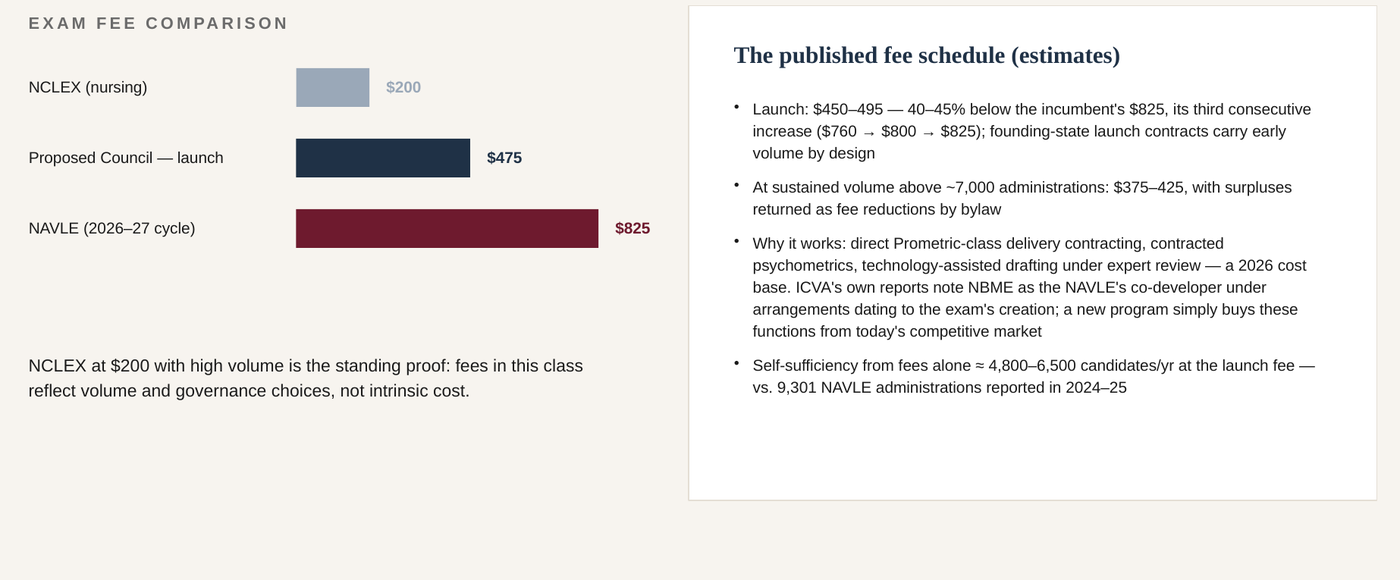
From the summary deck: the published fee schedule (estimates) against the incumbent — the $200 National Council Licensure Examination (NCLEX) benchmark, a $450–495 launch fee stepping down as adoption grows, and the NAVLE’s $825 for 2026–27.
State rules do not answer the threshold question — whether mandatory reliance on an unverifiable examination is defensible. They implement the answer. Path B is the realistic opening: individual boards amend their rules to accept either examination, and the new instrument earns adoption state by state — in most states, board rulemaking under existing approved-examination authority, with no new statute required. Path A is full succession: the boards collectively adopt the new examination and retire the old one.
Path C is the contingency nobody chooses. If a court order, consent decree, federal agency action, or Attorney General enforcement action ever determines that continued reliance on the incumbent gate is unlawful or indefensible, state licensing rules become implementation mechanics — and the continuity machinery in these papers executes the transition. Licensed veterinarians stay licensed; candidates who have passed keep their scores; the forward flow of new graduates is bridged through temporary permits, supervised practice, and emergency rules while examination-based licensure resumes on the nine-to-twelve-month default schedule. Feasibility objections are answered; continuity cannot be the excuse for delaying accountability.
Modern drafting tools may assist item development, but every scored item would be veterinarian-authored-of-record, reviewed, bias-screened, pretested, and psychometrically validated — with annual technical reports and independent scoring audits required by bylaw.
NAVEC contributes the research, the designs, the cost model, and the public case. It will hold no seat on any board, no veto over any decision, no contract with any proposed institution, and no financial interest in the outcome. Working names are placeholders; naming, incorporation, and governance belong to the founders — state boards, a compact, universities, philanthropy, and the profession.