Animals Are Running Out of Time While Shelter Veterinary Jobs Sit Empty
For everyone fighting for the animals most at risk — shelter teams, rescue volunteers, fosters, clinicians, and advocates — the veterinary shortage is not a workforce statistic. It is a preventable-deaths crisis. And its root cause is now part of the federal antitrust record.
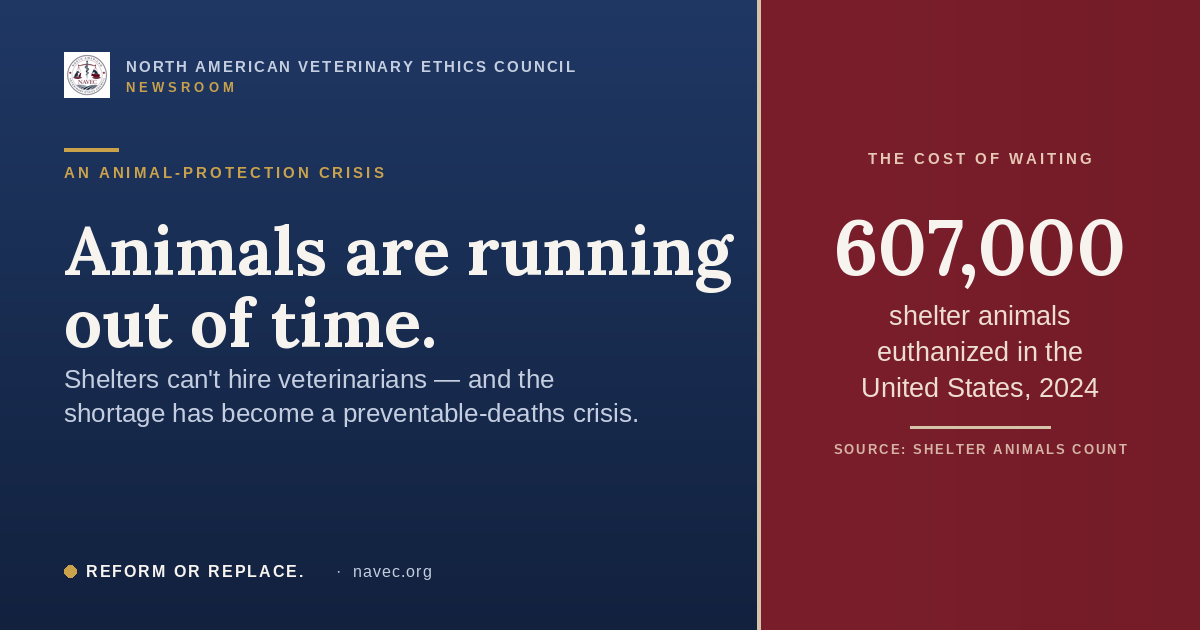
Ask any shelter operator or nonprofit clinic leader what is breaking, and you will hear the same sentence: We cannot hire veterinarians.
Not enough to run the surgery schedule. Not enough to treat the animals already in care. Not enough to keep families from surrendering pets they wanted to keep. Not enough to stop today’s backlog from becoming tomorrow’s euthanasia decision.
For the animals most at risk, the shortage is not first measured in charts. It is measured in empty surgery slots, longer shelter stays, untreated infections, delayed medical clearances, disease outbreaks, harder triage — and in preventable deaths that grow month after month while shelter and nonprofit positions go unfilled.
The people closest to the crisis have been warning us. A California statewide shelter survey found that more than half of budgeted veterinarian and veterinary-nurse positions sat unfilled because shelters could not find candidates — and that nearly two-thirds of shelters could not provide basic medical care.
The vacancy reality — California statewide shelter survey
Dr. Jennifer Scarlett, CEO of the San Francisco SPCA, has called inequitable veterinary access the greatest threat to companion-animal welfare of our generation. Kate Hurley of the UC Davis Koret Shelter Medicine Program put the moment plainly: this industry, she said, is in a time of crisis right now.
The same pattern repeats across the country. In South Carolina, the Charleston Animal Society reported that animals “could be adopted but aren’t” because they had not yet been spayed or neutered. Its president and CEO, Joe Elmore, did not reach for nuance: the house, he said, is on fire now.
The shelter cascade
This is how a single unfilled position becomes a life-or-death problem. It is not abstract. Every shelter team can trace the chain in their own building.
Shelter teams are not failing animals. Rescue volunteers are not failing animals. Fosters are not failing animals. Nonprofit clinicians are not failing animals. They are being asked to save lives inside a shortage they did not create.
The shortage the official numbers keep missing
For years, the public has been told the shortage is modest or self-correcting. The AVMA’s 2023 forecast projected a surplus of roughly 8,200 companion-animal veterinarians by 2030, and the association’s public messaging framed the outlook as no dire shortage ahead. Yet even an AAVMC-commissioned workforce paper described the field’s projections as conflicting, noted that the AVMA forecast leaned on imperfect demand proxies, and concluded that projected graduates would meet only about 76% of growth-and-turnover need through 2032.
NAVEC’s own needs-based assessment, published on the NAVEC research page, takes a different approach. Instead of counting licenses on paper or relying on market proxies, it rebuilds demand from animal populations, standards of care, and the veterinary work actually delivered. By that method, the picture inverts.
Two models, opposite conclusions
So the real question is not whether there is a veterinary shortage. Shelters answer that every day. The real question is: why does the system keep producing one?
The structural cause
The answer is structural. For decades, veterinary medicine treated oversupply as the danger to guard against. The profession held to a narrow school pipeline while animal-care demand grew, while families expected more care, while shelters absorbed more medical work, and while nonprofit clinics became a safety net for communities priced out of private practice. The result is a profession whose entry gates never expanded with the need.
Those gates are not public systems answerable to voters, legislatures, or independent regulators. A single private professional association remains the sole accreditor of U.S. veterinary colleges through the AVMA Council on Education. A separate private organization — the ICVA — controls the one licensing exam, the NAVLE, that every U.S. and Canadian veterinarian must pass. These are not administrative footnotes. They determine who may train, who may test, and who may enter the profession at all.
This is no longer just an advocacy claim
The conflict-of-interest concern is now part of the federal antitrust record.
In December 2025, the U.S. Department of Justice filed a statement of interest in a private lawsuit challenging AVMA accreditation standards and procedures. The DOJ told the court that professional accreditation societies like the AVMA cannot erect anticompetitive hurdles that restrict entry into veterinary services. It warned that accreditors are typically made up of interested market participants who set standards behind closed doors, and that they face an inherent conflict when they regulate admission into a profession.
The DOJ took no position on the plaintiff’s allegations. But it confirmed the central public-interest concern: veterinary accreditation standards and procedures are not above antitrust scrutiny simply because states rely on accredited schools for licensure.
That matters, because the animal-protection community has spent years surviving the consequences of a shortage without a plan to fix the machinery that produces it.
Effort was never the problem
There has been no shortage of effort. Shelters have recruited harder. Clinics have offered more. States have debated loan repayment. Universities have proposed new programs. Nonprofits have tried relief-vet models. Rescue networks have stretched themselves thinner. Every one of those efforts matters — and not one of them, by itself, changes the gatekeeping system. That is the missing piece.
The blueprint already exists
Human medicine did not solve physician access by leaving every gate in one private bottleneck. The United States maintains separate accredited pathways for MD and DO education — the LCME and COCA are each recognized by the U.S. Department of Education — and a defined certification route for qualified international medical graduates. And when the USMLE Step 2 Clinical Skills exam became an outdated bottleneck, its sponsors permanently discontinued it rather than defend a barrier that no longer served the public.
Veterinary medicine can do the same kind of thing: restore genuine accountability over the licensing exam, create fair pathways for qualified internationally trained veterinarians, and return public authority to public oversight, with the active supervision the law expects when a profession’s gates are run by private hands. That is not radical. It is simply how a profession expands when public need grows.
NAVEC’s plan is not to lower standards. It is to make the standards public, accountable, competitive, and capable of meeting the country’s animal-care needs. High standards should protect animals. They should not manufacture a shortage that leaves animals without care.
For shelters, this was never theory
It is whether the job posting gets filled. Whether the surgery day happens. Whether the adoption can move forward. Whether the sick kitten gets treated. Whether the dog with a treatable condition gets another chance. Whether a shelter worker has to make one more impossible decision before lunch.
The animal-protection community has always known how to show up when animals have nowhere else to go. Now the movement has to show up upstream, at the gate. The veterinary shortage was built by policy choices. It can be unbuilt by policy choices — and NAVEC is organizing the coalition to do it.
Join the coalition → Bring your clinic, shelter, rescue, organization, expertise, or platform into the fight. Share your story, volunteer, help organize state by state, and support fair, transparent, merit-based pathways so more qualified veterinarians can serve the animals most at risk.This article draws only on public, citable sources, including the U.S. Department of Justice’s December 2025 statement of interest, the AVMA and AAVMC workforce literature, Shelter Animals Count, and named statewide reporting from animal-welfare organizations. It does not assert that any individual or entity has committed misconduct. It identifies a structural concern — the concentration of accreditation, testing, and licensure in private hands without independent oversight — and the public record now bearing on it. It is not legal advice.