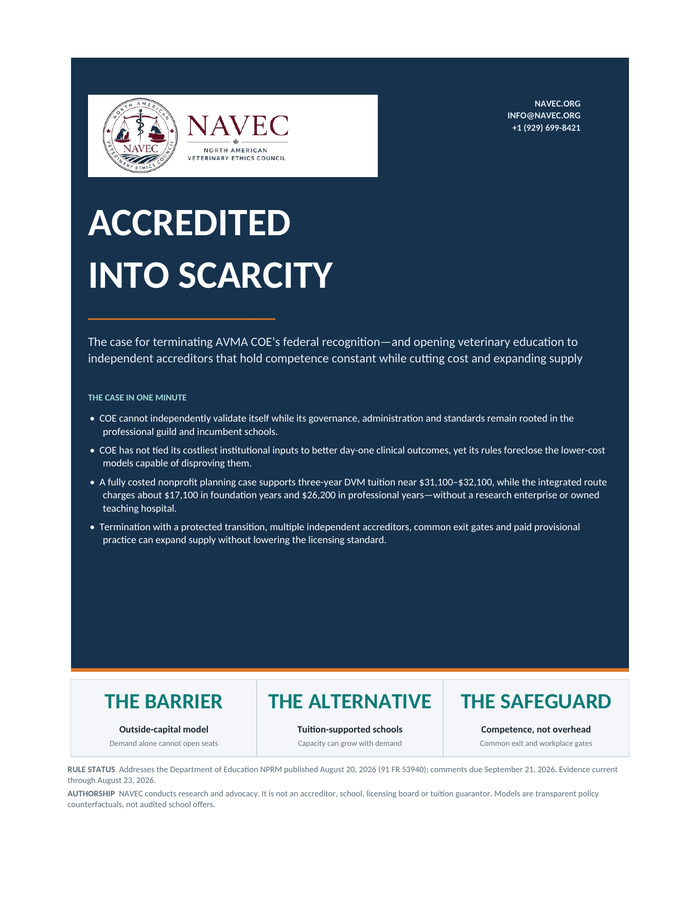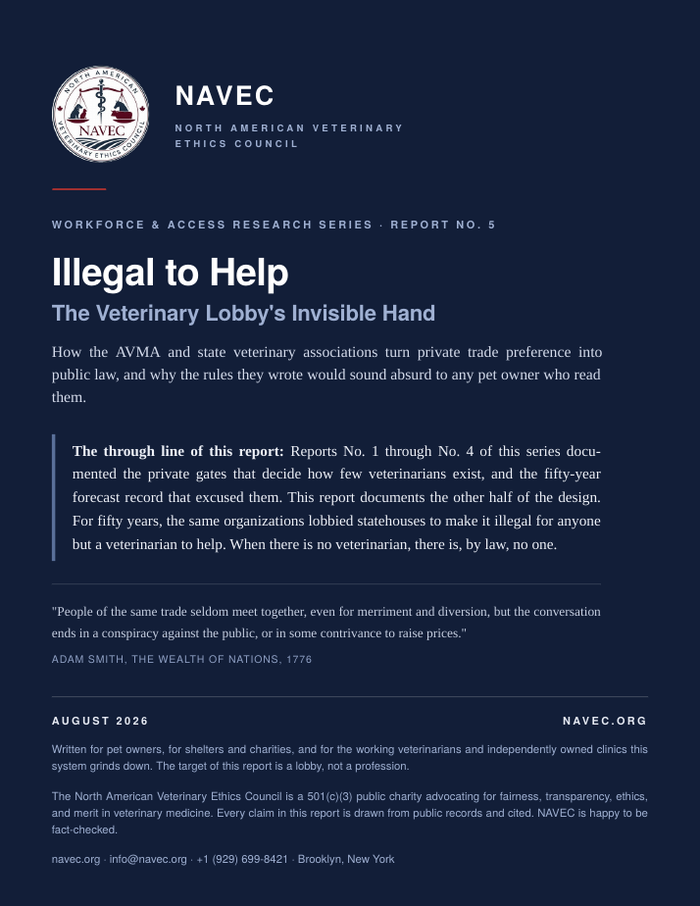
Research

Research & Reports

The evidence behind the case. NAVEC's research rebuilds the veterinary workforce question from primary data — animal populations, standards of care, and the profession's own figures — and assembles the public record on competition in veterinary education and licensing. Every load-bearing number is sourced and citable.

Cover of The Gatekeepers and the Gate, NAVEC Integrity & Accountability Research Series, Report No. 4
Investigative Study · Report No. 4

The Gatekeepers and the Gate

How a Half-Century of Surplus Forecasts and Control of the Licensing Gate Built the Veterinary Shortage

NAVEC · June 2026  ·  19 pages  ·  PDF

Two private organizations stand between a veterinary student and a license to practice: the AVMA Council on Education, the sole federally recognized accreditor of veterinary colleges, and the ICVA, which owns the single examination every U.S. and Canadian jurisdiction requires for licensure. This study assembles, for the first time in one place, a fact the public record can carry on its own weight — that the institution controlling the accreditation half has, for roughly fifty years, repeatedly forecast a surplus of veterinarians, even as the forecasts whose target years have now arrived were largely not borne out. It alleges no conspiracy and imputes no intent. It documents a structure — interested private bodies regulating the conditions of their own competition, insulated from the market correction scarcity would normally produce — and characterizes that structure as the one the Supreme Court addressed in NC State Board of Dental Examiners v. FTC, and into which the Justice Department intervened on December 15, 2025, telling a federal court the arrangement is “not exempt from the antitrust laws.”

50 yrsOf recurring institutional surplus forecasts, 1978–2013
<1%Veterinarian unemployment by 2025 — against decades of oversupply warnings
2 of 2Halves of the licensing gate held by interested private bodies
Cover of Reform on the Medical Model, NAVEC Workforce & Access Research Series, Report No. 3
Workforce Study · Report No. 3

Reform on the Medical Model

How Adopting Human-Medicine Policies Would End the Veterinary Shortage

NAVEC · June 2026  ·  21 pages  ·  PDF

The United States is roughly 25 percent short of the veterinarians it needs, and the gap widens every year — yet the country opens only about five new veterinary schools a decade, admits around 168 internationally trained veterinarians a year, and licenses every entrant through a single privately owned exam with no government oversight and no appeal. This study argues the shortage is not an accident of demand but the engineered result of a credentialing architecture built around three supply-restricting gates. Human medicine faced the same pressures and opened all three — competing accreditors, a scalable national credential for foreign-trained graduates, and the 2021 elimination of its own hands-on bottleneck exam — without lowering the standards that protect patients. The reform is therefore not speculative; it is observed, at scale, in the larger profession next door.

3Supply gates one professional establishment controls
168Internationally trained vets admitted a year — against 9,682 doctors
5 / decadeNew veterinary schools opened — against ~2 medical schools a year
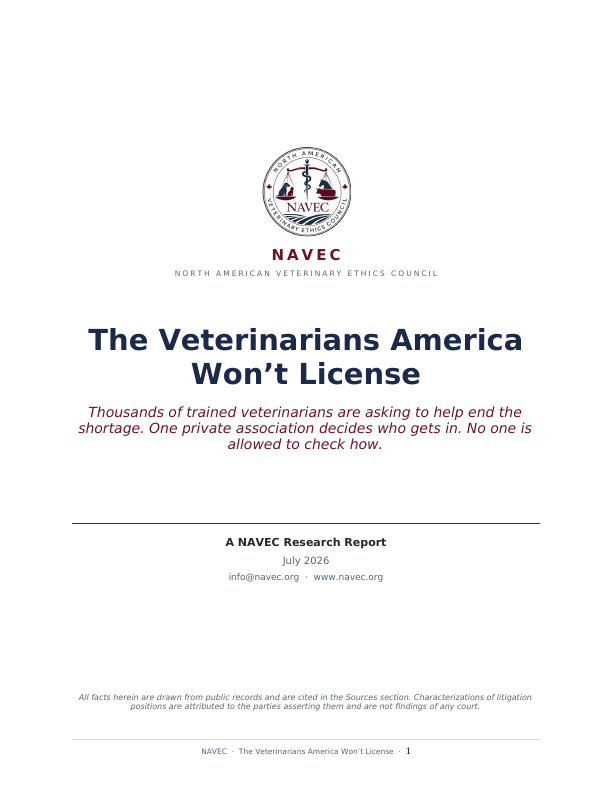
Cover of The Gatekeeper No One Can Audit, NAVEC Integrity & Accountability Research Series, Report No. 2
Investigative Study · Report No. 2

The Gatekeeper No One Can Audit

How an Unaccountable Private Monopoly Built a Black Box Around the One Exam That Decides Who May Practice Veterinary Medicine

NAVEC · June 2026  ·  24 pages  ·  PDF

A single private organization — the International Council for Veterinary Assessment (ICVA) — writes, scores, and owns the NAVLE, the one examination every veterinarian in the United States and Canada must pass. This study documents how that monopoly answered a wave of fairness complaints not by opening its records, but by rewriting its candidate agreement and adopting a sole-discretion ethics policy that lets it investigate, withhold scores from, ban, and silence the very people who might testify. Measured against the four accountability features common to other major licensing exams — auditable questions, published fairness data, a compelled rescore, and verifiable scoring — the NAVLE fails all four, leaving neither the allegations nor ICVA's denials independently testable from the outside.

1Exam every U.S. and Canadian veterinarian must pass
0Independent external audits of its scoring
4/4Accountability features the NAVLE fails
Cover of The Veterinary Shortage: A Need-Based Assessment
Flagship Report

The Veterinary Shortage

A Need-Based Assessment

NAVEC · June 2026  ·  20 pages  ·  PDF

Official projections describe a veterinary shortage that is modest and self-correcting — the AVMA forecasts a surplus of roughly 8,200 companion-animal veterinarians by 2030. This report rejects that conclusion. Rebuilding demand from raw animal populations and published standards of care, and measuring supply by hours of work actually delivered rather than license count, it finds a 2026 shortfall equal to roughly 37,000 full-time veterinarians, widening toward 83,000 by 2031.

37,000Full-time veterinarians short in 2026
83,000Projected shortfall by 2031
+8,200The surplus official projections expect

Analysis & source documents

Newsroom Investigation A Bribe, a Gag, and a Confession: How a Veterinary Monopoly Answered Its Critics

NAVEC Newsroom · June 2026

A readable companion to the study: how ICVA met a fairness challenge by changing the rules and arming itself against the people asking questions — and why the resulting secrecy means its own denial cannot be tested either.

Read →
Primary Source NAVLE Candidate Agreement

International Council for Veterinary Assessment (ICVA) · PDF

The binding contract every candidate must accept to sit the exam. It reserves to ICVA the sole-discretion right to withhold, cancel, or invalidate scores through statistical analysis — with no appeal and no refund — alongside broad confidentiality terms and the right to report a candidate to licensing boards mid-investigation.

Open →
Primary Source ICVA Ethical Behavior Investigation and Appeal Policy

Adopted by the ICVA Board of Directors · November 25, 2025 · PDF

The policy governing sole-discretion investigations, score holds, and sanctions. Appeals are heard by a three-member panel that ICVA itself appoints, with no hearing, no testimony, no new evidence, and a decision that is final — and findings may be shared with licensing boards, the AAVSB, employers, and other “legitimately interested third parties.”

Open →
Newsroom Analysis Counted by need, America is short 37,000 veterinarians — and climbing

NAVEC Newsroom · June 2026 · 8 min read

A readable walk through the report's core finding: how counting care instead of licenses, and hours instead of head-count, turns the official surplus into a deep and widening shortage. With charts.

Read →
Federal Filing U.S. Department of Justice — Statement of Interest on veterinary accreditation

U.S. Department of Justice, Antitrust Division · December 15, 2025

The DOJ tells a federal court that veterinary accreditation standards are subject to antitrust scrutiny, and that an accreditor cannot erect anticompetitive hurdles that restrict the number of veterinarians entering the profession. Background to the report's reform section.

justice.gov ↗

About these materials. NAVEC research uses only public, citable data; full citations appear as footnotes within each report. Source documents published by other organizations are linked to their original location and are the work of those organizations, not of NAVEC.