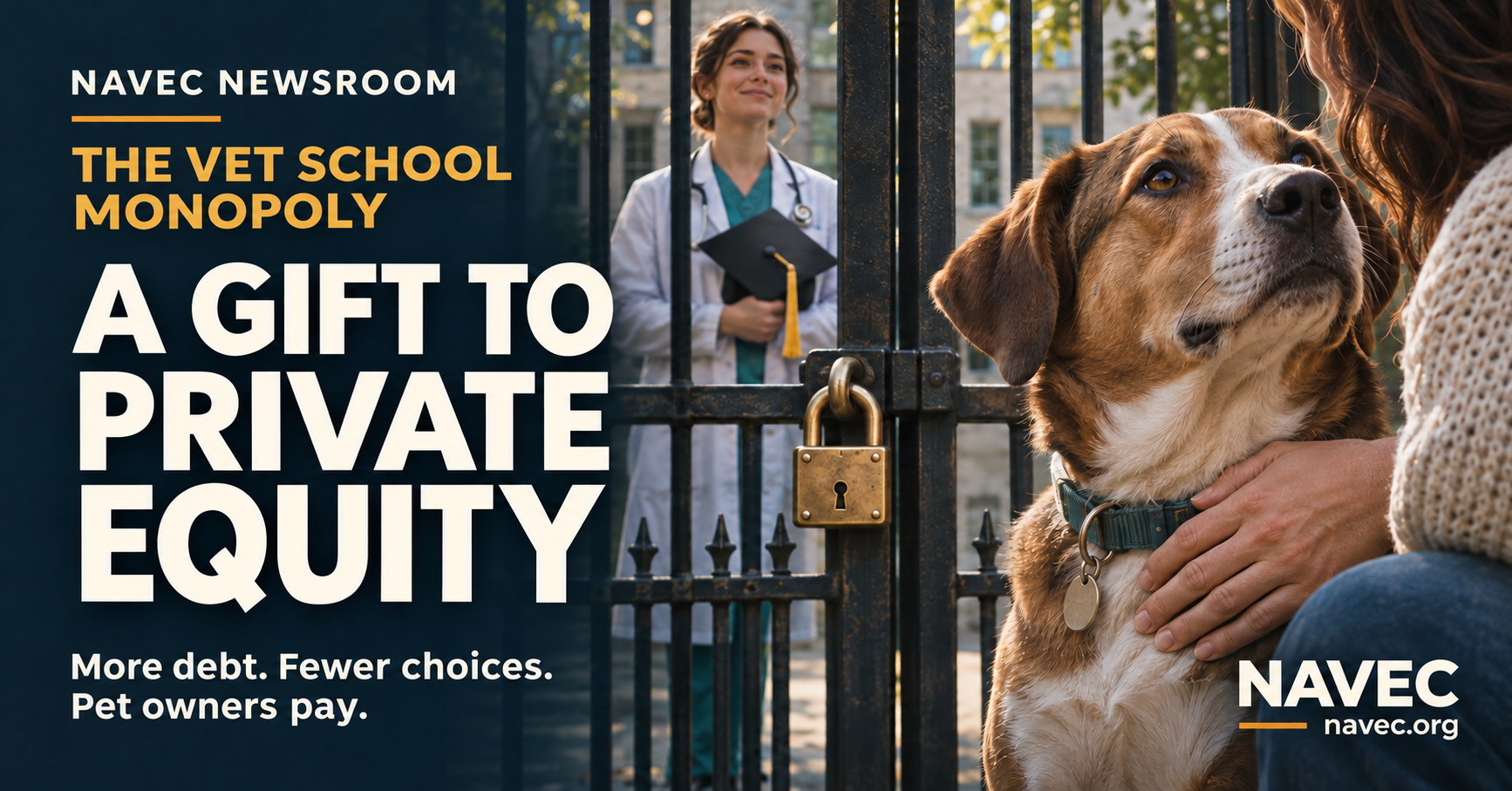
Picture Julie in her final year of vet school. Her hero growing up was the elderly vet whose clinic she volunteered in, a woman who knew every family and found ways to help when money was tight.
Julie wants to follow in her footsteps. But first, she has to pay for becoming a vet.
New vets who borrowed leave school with nearly $228,000 in vet-school debt on average, and many owe $400,000 or more. 1
Then a corporate clinic offers a signing bonus of up to $100,000. A clinic backed by private equity advertises exactly that, with new graduates welcome. Julie's small hometown clinic may have no way to match it. 2,3
Her dream has not changed. Her choices have.
When vets are hard to find and care is hard to afford, families pay the price. Saving a beloved pet can mean going into debt. More than half of U.S. dog and cat owners (52%) said their pets went without needed care in the past year. Cost was the leading reason. Shelters and nonprofits are among the hardest hit. Many simply cannot compete for the vets they desperately need. 4,5
An older vet needs someone to take over. A young vet needs help with debt. A chain has money for both.
That is one way a local clinic becomes part of a corporate chain without its clients ever choosing that change.
Behind those choices sits a private group most pet owners have never heard of.
The American Veterinary Medical Association, or AVMA, is a professional guild that represents vets. Its Council on Education approves vet schools. That stamp is called accreditation. State licensing laws make it the main gateway into the profession across the country. 6
The group representing today's vets also holds the main key to training tomorrow's.
The council sets broad goals for training vets. Each school decides many details. There is no common, detailed list of procedures every graduate must perform and pass. Yet the rules spell out costly demands for research, staff, and facilities. 7
They are clearer about what a school must have than the exact skills every vet must prove.
The scale of that model is startling. Data from the vet schools' own national association show that even huge tuition and fees supply only about 15% of the average vet college's total budget. Those budgets cover research and hospital services as well as teaching. 8
NAVEC argues that these costly demands make affordable schools harder to build. That means fewer ways to train new vets and more debt for people like Julie. Families need help, while eager students still compete for limited places to train.
Why defend a system that makes it so hard to add more help?
For nearly half a century, AVMA-backed studies have warned about having too many vets. 9
AVMA has also opposed new veterinary roles like physician assistants in human medicine. It opposes letting vets start treating a new patient through an online visit alone. 10,11
And the profession's lobbying network has fought charities offering cheaper care.
In Alabama, a proposed rule would have barred charities from owning the medical tools their licensed vets used. The ASPCA warned it could close all four nonprofit spay-and-neuter clinics. Public opposition helped stop it. 12
In South Carolina, a shelter-linked mobile vet clinic cannot operate within sight of the nearest private vet practice. A charity can be kept away because a competitor can see it. 13
AVMA has advised state vet groups on shelter laws. The Texas vet association's own plan listed nonprofit competition as a threat. 14,15
For families who cannot afford care, that charity could be their last hope.
Rules that make it harder to train vets or offer cheaper care can help the biggest chains. They have the money to recruit scarce vets and buy clinics whose owners struggle to find a successor.
When vets are hard to find, deep pockets can beat a local clinic's long ties to its community.
Federal officials have taken notice.
The Justice Department has warned that AVMA cannot use school approval to unfairly keep new vets out. The Department of Education has issued new rules to keep trade groups from controlling school approval and open the door to lower-cost education. 16,17
But AVMA's response leaves a loophole that could preserve its power.
AVMA has announced plans for a new accreditor that can meet federal rules. It has also said schools will remain accredited by its existing council, which can keep operating without federal recognition. 6,18
A school could meet the new federal rules and still need AVMA's stamp so its graduates can get licensed.
An independent accreditor could approve a good, cheaper school without demanding the old costly model. But if state law still names AVMA's approval as the main path to a vet license, the school would still need that approval for its graduates to follow that path.
And getting AVMA's approval would still mean meeting its costly requirements, even if the new accreditor does not require them.
Federal approval could change while AVMA still decides what the school must pay for.
That is the loophole. Unless states open their licensing rules to other qualified accreditors, federal reform alone could leave the old costs in place. Pet owners need to help make that state-level change happen.
NAVEC's report, Accredited Into Scarcity, shows how a five-year college-and-vet-school program could support itself with tuition averaging about $22,500 a year. Graduates would then enter paid, supervised practice, with independent checks of their skills. 19
The plan needs funding and approval, and living costs are extra. Its goal is straightforward: train more good vets without burying them in debt.
Julie could have more freedom to join the clinic that inspired her. Her mentor could have someone to carry it on. Your family could keep another door to care open.
NAVEC, the North American Veterinary Ethics Council, is organizing pet owners, vets, and independent experts to change these rules.
Join us. Help build a chapter in your state. Tell lawmakers that affordable care and more qualified vets must come first.
The guild has a voice. The chains have money. Our pets need us to show up.
Join NAVEC: help keep care within reach.
Sources and supporting documents
- AVMA, preliminary 2026 Senior Survey findings, as reported by dvm360, October 9, 2026. Mean DVM debt among borrowers $227,588; mean including debt-free graduates $185,424; 7.9% owed at least $400,000. Excludes undergraduate and other educational debt. Survey covered U.S. colleges and two Caribbean colleges; full report expected in 2027.
- Alliance Animal Health, Plum Creek Animal Medical Center job posting. Advertised maximum signing bonus $100,000; new graduates encouraged to apply. Viewed November 11, 2026.
- L Catterton, investment in Alliance Animal Health, January 20, 2022.
- Gallup, 52% of U.S. Pet Owners Skipped or Declined Veterinary Care, April 15, 2025. Survey of 2,498 U.S. dog/cat owners, November 2024–January 2025. The figure covers skipped needed visits or declined recommended care in the prior year, not complete lack of access. Cost was the leading reason.
- San Francisco SPCA, CalAnimals and Veterinary Care Accessibility Project, Access to Veterinary Care in California Animal Shelters, 2025 survey. Survey of 103 responding shelters; reported veterinarian vacancy rate 20.1%. This is not a national vacancy estimate.
- Lisa Wogan, VIN News, “AVMA to create new accrediting entity,” November 9, 2026; AVMA announcement. AVMA's public language describes a transition; it does not establish a permanent dual-accreditor plan. The state-law analysis concerns the main licensure path; alternative routes exist in many states.
- University of Pennsylvania, published COE Standards 8–11; Iowa State University, Standard 10: Research Programs. COE requires broad curriculum, clinical competencies, assessment and remediation. External clinical teaching sites are allowed; school ownership of a hospital is not universally required.
- American Association of Veterinary Medical Colleges (AAVMC), 2025 Annual Data Report, College Revenue by Category at U.S. Colleges of Veterinary Medicine. The chart gives a mean 2025 total college budget of $114,912,041. Tuition/fee revenue is approximately 15% of that total. The percentage is an approximate reading of the chart, not a printed exact 15% statistic. Budget here refers to whole-college income, including support for research, clinical services and other activities; it is not a teaching-cost allocation.
- Michael R. Dicks, AVMA Veterinary Economics Division, A short history of veterinary workforce analyses, JAVMA, April 15, 2013; author-posted full text. Documents the AVMA-commissioned 1978 Arthur D. Little report and later forecasts. See also AVMA’s 2013 workforce announcement. The article does not assert that every forecast failed; excess-capacity models measure demand at prevailing prices, not whether every animal needing care receives it.
- AVMA-authored article, Proposed midlevel role poses unacceptable risks, October 30, 2024. Describes the association’s opposition to proposed veterinary midlevel roles and urges members to organize against them.
- AAHA, The patchwork quilt of state veterinary telehealth laws, October 7, 2024. Direct interview with AVMA chief veterinary officer Gail Golab. AVMA opposes establishing the veterinary-client-patient relationship through a virtual visit alone; it supports telehealth within an established relationship. The article does not claim opposition to all telemedicine.
- ASPCA, Alabama proposed rule and rejection, October 10, 2012; dvm360, equipment-ownership restriction and board vote.
- South Carolina Code, section 40-69-295(B). Applies to mobile practices affiliated with, operated by, or supported by an animal shelter.
- TVMA, 2018–2023 Strategic Plan, threats analysis.
- AVMA, 2014–2015 Annual Report, state advocacy section. Documents national AVMA advice and convening; does not establish that it directed every state action.
- U.S. Department of Justice, Veterinary accreditation standards and procedures are subject to antitrust scrutiny, December 15, 2025; statement of interest. DOJ explained that accreditors cannot impose anticompetitive restrictions on entry, while expressly taking no position on the truth of the plaintiff’s allegations. It did not find AVMA liable for monopolization or determine that AVMA caused the shortage.
- U.S. Department of Education, final accreditation rule, October 30, 2026. Most provisions effective July 1, 2027; separate-office requirement effective July 1, 2028.
- CHEA, AVMA Council on Education recognition listing, together with AVMA's announcement above.
- NAVEC, Accredited Into Scarcity, full report and cost model, especially printed pages 14–16 and 29. The five-year integrated model totals $112,697 in tuition: about $17,060 in each of the first two years and $26,192 in each of the last three. About $22,500 is the rounded annual average, followed by a paid supervised practice year without tuition. This is a planning model, not an open-school offer or total cost of attendance.