Independence
COE cannot independently validate itself while its governance, administration, and standards remain rooted in the professional guild and incumbent schools.
The case for terminating AVMA COE’s federal recognition—and opening veterinary education to independent accreditors that hold competence constant while cutting cost and expanding supply.
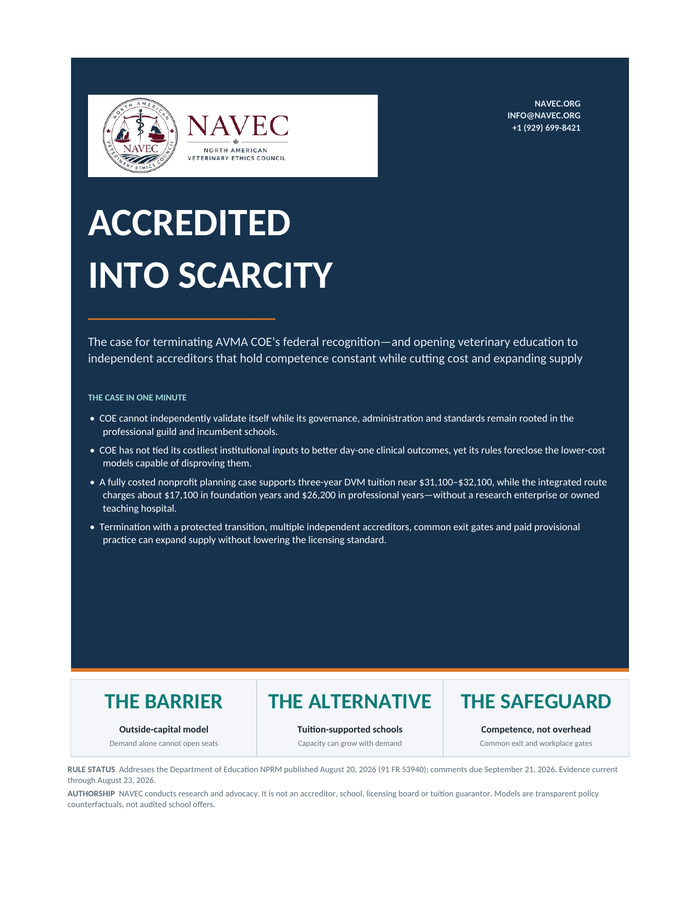
The report applies the Department’s proposed independence, competition, evidence, cost, and outcomes tests directly to veterinary accreditation.
COE cannot independently validate itself while its governance, administration, and standards remain rooted in the professional guild and incumbent schools.
COE has not tied its costliest institutional inputs to better day-one clinical outcomes, yet its rules foreclose lower-cost models capable of testing whether those inputs are necessary.
Fully costed nonprofit planning cases show that tuition-supported schools can operate at materially lower prices without a research enterprise or university-owned teaching hospital.
A protected transition, multiple independent accreditors, common exit gates, and paid provisional practice can expand supply without lowering the licensing standard.
The filing separates the expensive institutional architecture from the competence standard the public actually needs.
Demand for more seats cannot by itself finance a new school built to an incumbent cost structure in which tuition supplies only a small share of total revenue.
Independent, branch, and integrated BS/DVM models are costed to recover operating expense, reserve, and startup debt entirely from tuition.
Common independent knowledge and clinical gates, followed by paid provisional practice and workplace assessment, protect patients while allowing different educational models to compete.
Terminate, suspend, or decline renewal of COE’s federal recognition on the present record rather than treating structural independence and proof failures as matters for another paperwork revision.
Preserve the status of enrolled students and existing graduates through a defined transition, while rapidly recognizing multiple qualified successor accreditors under common public outcome and patient-safety floors.
States should accept graduates of any federally recognized veterinary accreditor and remove statutory language that makes AVMA COE the exclusive route into the standard licensure pipeline.
Governance, administration, professional perception surveys, the LMU record, and the difference between customary inputs and demonstrated outcomes.
Bottom-up budgets for an independent three-year DVM, a three-branch school, and a five-year integrated BS/DVM, including startup financing and paid clinical capacity.
A direct route from college entry to the DVM, followed by a paid provisional-practice year rather than another tuition-bearing year.
The NAVLE, ICVA, ECFVG, the foreign-only CPE standard, supply forecasts, access-to-care effects, and a protected termination-and-transition plan.
The embedded viewer contains the complete 33-page report. The PDF opens separately for easier downloading, printing, citation, and sharing. View the actual filing online ↗
NAVEC Policy Report · August 2026
Authorship and scope. NAVEC conducts research and advocacy. It is not an accreditor, school, licensing board, or tuition guarantor. The school and tuition models in the report are transparent policy counterfactuals, not audited school offers.