If the nearest vet is an hour’s drive, if the last bill made your chest hurt, if the shelter wanted to help your dog and the law wouldn’t let them: none of that happened by accident. Somebody wrote those rules, one by one, out of sight. This is the story of who, told plain, from a new 63-page report where every fact is checked and sourced.
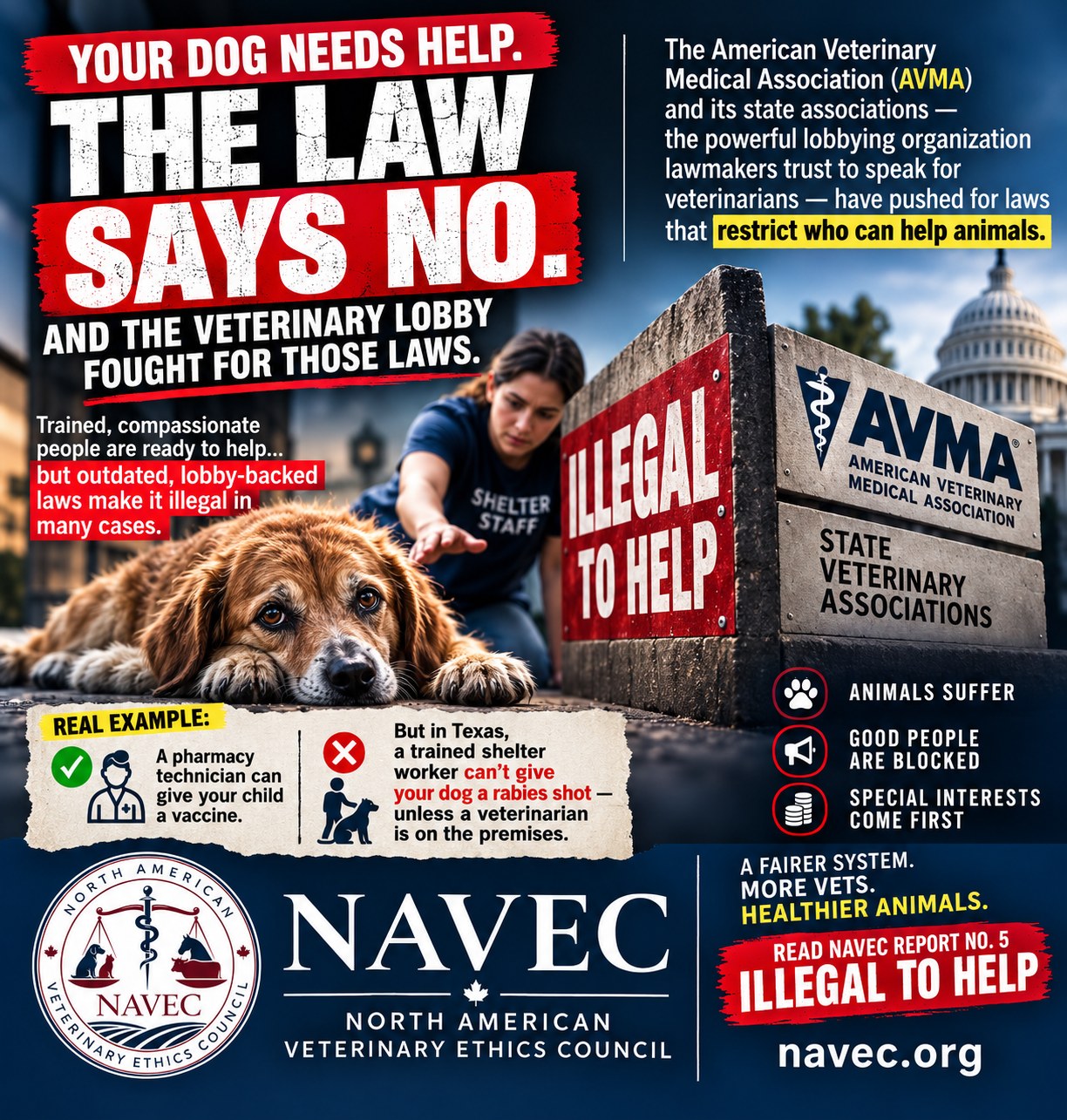
Say your dog needs his rabies shot. The law says he must have it. Now try to get it.
If you live in a small town in Mississippi or Texas, you may know how this goes. The vet you grew up with retired, and nobody came to take his place. The nearest clinic is a long drive. They’re booked for weeks. And when you finally get in, the shot comes with an exam fee, and the visit costs more than your own doctor charges you.
Here is the part almost nobody knows.
In North Carolina, the state trains regular people to give animals the rabies shot. The class takes about four hours. Church volunteers, shelter workers, county folks. They’ve done it for decades, and it works fine.
In Texas, that same shot is against the law unless a veterinarian is standing right there on the property. Not on the phone. In the building.
Same shot. Same disease. Same country. In one state, a trained neighbor can give it after a four-hour class. In another, it’s illegal without a doctor of veterinary medicine on site. One of those rules is not about safety.
And here’s the kicker. The parvo shot, for a disease that kills far more dogs than rabies does, sits on the shelf at the feed store. You can buy it and give it yourself. Nobody stops you. The rabies shot is the one the law makes you pay a veterinarian to deliver.
Still wondering whether this is about safety or money? Virginia answered that. In 2023, a lawmaker proposed capping the price of a rabies shot at $20, and making it illegal to force extra services on you to get it. The state’s veterinary association opposed the idea. Lawmakers threw it out on a unanimous vote. Not the training. The price.
Who writes rules like that? Hold on to the question. It gets worse first.
In Arizona, a woman named Celeste Kelly massaged sore horses for a living. The state veterinary board sent her a letter: stop, or face six months in jail and thousands in fines. Her crime was rubbing horses without a veterinary degree. It took a constitutional lawsuit to make the board back down.
In Maryland, Mercedes Clemens was a licensed massage therapist for people. She was ordered to quit massaging horses or face criminal prosecution, and they threatened to take away her human massage license too. A court later found the board had acted illegally.
When Tennessee sent the same jail-threat letters to two horse massage practitioners, the federal government’s own competition experts wrote the legislature a letter. It contains a sentence worth framing: training in animal massage is not even required to graduate from the University of Tennessee’s veterinary college. The rule handed massage to the one profession never trained to do it.
It’s not just massage. Filing down horses’ teeth has been barn work for as long as America has had horses. In 2007, the Texas board mailed threats of prosecution, fines, and jail to ten teeth-floating practitioners in a single sweep. A judge struck the whole campaign down.
And physical therapy. A licensed physical therapist can treat your bad knee in every state, no doctor in the building. In most states, that same licensed therapist risks prosecution for working on your dog’s bad knee unless a veterinarian supervises. When California tried to loosen that rule, the state veterinary association’s official argument included this line: physical therapists cannot call 911 if an animal has an emergency.
There is no 911 for dogs.
Maybe you figured the animal shelter could help you in a pinch. Texas law forbids it. A shelter can have a veterinarian, an exam room, and your sick dog right there in the lobby. If the dog needs to be spayed, helping is legal. If the same dog has an ear infection, treating it is against the law unless your family proves it is poor enough. A bill to fix this passed the Texas House by a landslide. It died quietly in a Senate committee. It was filed again in 2025. It never even got a hearing.
Alabama went further. Its veterinary board is, by law, appointed from lists the state veterinary association hands over. Starting around 2011, that board went to war against the state’s four nonprofit spay and neuter clinics. The board’s president claimed the state’s private vets already offered enough affordable care. One charity vet, Dr. Margaret Ferrell, faced 29 charges. The judge who heard her case found her not guilty of every single one. The board convicted her anyway, on three technicalities. Another charity vet had fixed 8,882 animals in 28 months. She closed her clinic rather than be next.
The federal government reviewed the whole Alabama record. Its experts reported the charity clinics had operated for years without a documented problem. Restricting them, the experts warned, would cut off care for people with no other option. The campaign against them continued anyway.
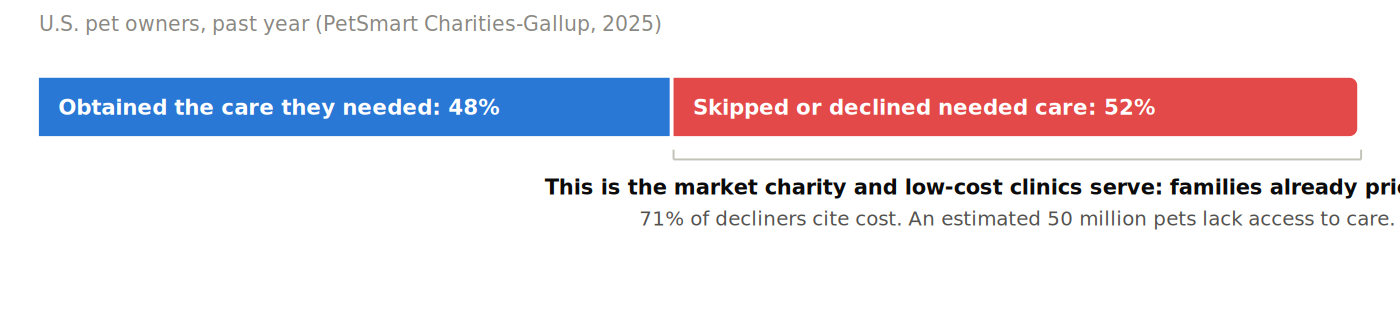
Remember, this happened in a country where more than half of pet owners, 52%, skipped or turned down needed care for their animal last year. Mostly over money. The clinics being punished were the ones helping.
One more. Your own doctor can see you by video now. Medicare pays for it. It saves country people a world of driving. But not your vet. In 39 of 51 places in America, counting D.C., the rules forbid it. A veterinarian can watch the fleas crawling on your dog, right there on the screen. She still cannot prescribe the monthly flea medicine until your dog is brought in and examined in person.
One retired Texas veterinarian, elderly and disabled, spent years answering pet owners’ emails, often for free. The state board punished him for it. He fought in federal court for eleven years and won. Nobody could point to one animal he had ever harmed. Not one.
So who writes rules this strange, and how do they become law without you ever hearing a word about it?
Meet the AVMA: the American Veterinary Medical Association. It is not part of the government. It is a private trade club for the business of veterinary medicine, headquartered near Chicago, with an allied association in every state. In Texas it’s the Texas Veterinary Medical Association. In Mississippi it’s the Mississippi Veterinary Medical Association.
First, the copy-paste. The club publishes a ready-made model law spelling out that only its profession may care for animals. And it says plainly what that model is for: the language “is intended for use in state statute.” Copy, paste, done. Most states did.
Second, the referees. In some states, the governor must appoint the veterinary licensing board from lists the club’s state association hands him. Remember Alabama’s board, the one that prosecuted the charity vets? Chosen from the association’s lists. The club picks its own umpires.
Third, the back door. When a rule is too ugly to pass in daylight, it rides in on another bill. In South Carolina, a small bill about prescription labels went into a committee and came out rewritten as a crackdown on charity clinics. The law that emerged says a nonprofit’s mobile clinic is prohibited from operating within eyesight of a private vet’s office. Within eyesight. Governor Nikki Haley vetoed it and named the authors: “pro-veterinary groups tacked this arbitrary and obstructionist provision onto an otherwise inoffensive Bill.” The legislature overrode her, almost unanimously.
Fourth, the quiet word. Sometimes there is no vote to watch at all. They say so themselves. The Texas association’s 2025 report to its members brags that after “extensive relationship-building” with a lawmaker, “we prevented this bad legislation from even being filed this session.” The fights you never hear about are the ones they win before the bill is even born.
Step back and look at the shape of this. One private club writes the law of its own trade. It helps pick the boards that enforce that law. Through its control of school approval and exams, it decides how many competitors exist. And when your lawmakers want advice about animals, they call that same club, as if it were a neutral expert instead of the industry itself.
Imagine the home builders wrote the building code, appointed the building inspectors, and decided how many builders got licenses. Nobody would call that protection. Everybody would know what to call it.
And notice who has no seat at any table in this story: the animals. There is no animal welfare authority checking any of these rules. No pet owner representative. The guild grades its own homework.
One detail tells you where animals rank. Veterinarians swear an oath, like doctors do. The words “and welfare” were not added to that oath until 2010. Not 1910. 2010. And sixteen years after adding those words, the same organization endorsed, in Congress, canceling the country’s strongest farm animal welfare law, in a letter its own members never saw.
How does a profession full of caring doctors end up represented like this? Because the members don’t run the club. Picture an old-fashioned union hall. Dues come in from everybody on the floor. The decisions get made in a back room by a handful of insiders. That is the AVMA’s own structure: policy is set by about 70 delegates, and the club’s own rulebook says regular members may vote in certain elections “and no other matter.” Its newest president-elect ran unopposed.
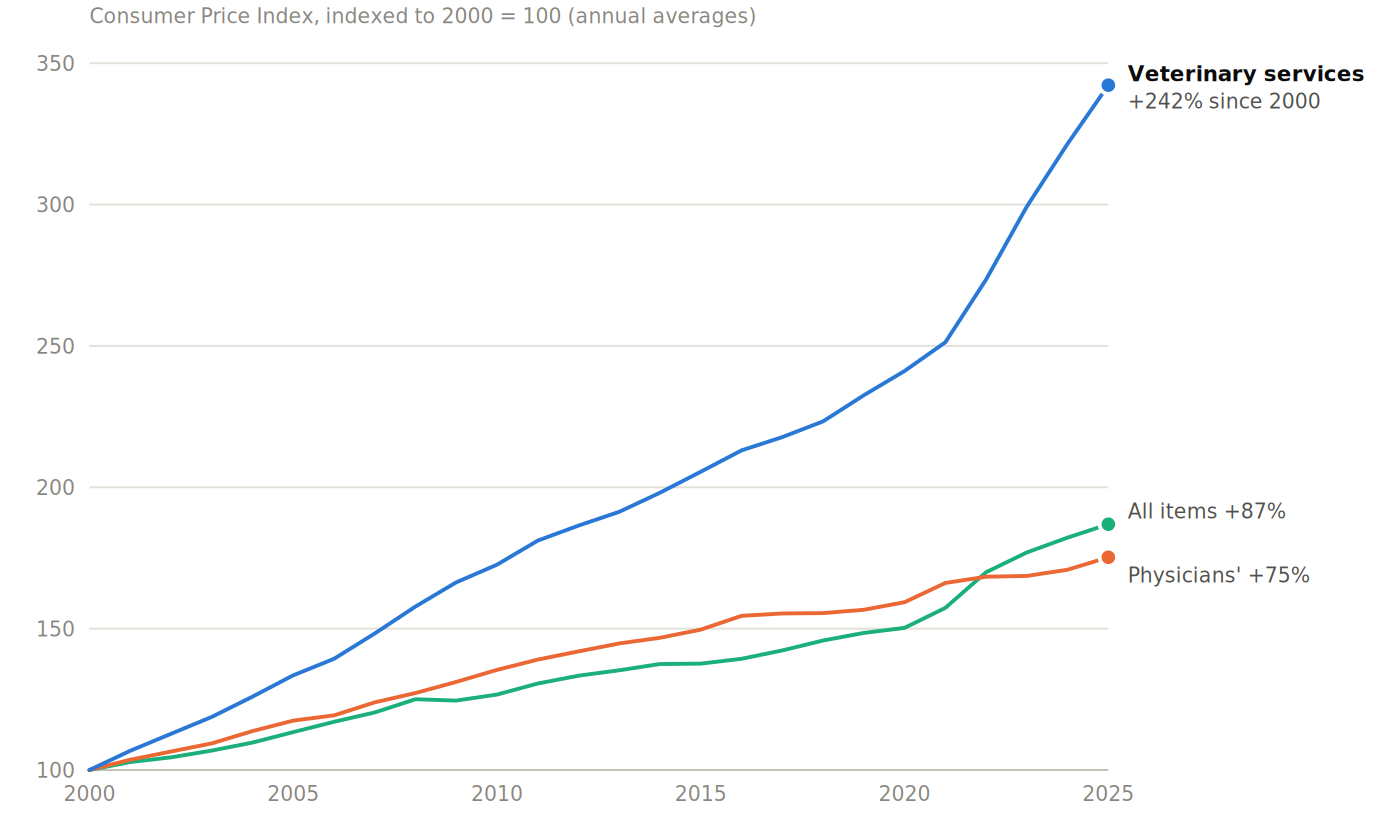
Your vet took an oath and keeps it every day at the exam table. She is as trapped as you are. The club lobbies in her name, spends dues she must pay to belong, and never asks her opinion. Fifty years of the club’s own studies said too many veterinarians were coming. Meanwhile the federal shortage list just hit 243 areas across 46 states. That is the longest it has ever been. There are 18 job openings for every vet looking for work. And vet prices have climbed 242% since 2000, while doctor visits for people rose 75%.
Here is where it all lands. A small clinic that is forbidden to hand any task to a helper eventually breaks. She cannot hire doctors who do not exist. The big chains, backed by more than $51 billion in Wall Street money, were waiting at the end of that road. Today, corporations own three out of four animal emergency hospitals and about half the whole business. Only one in five veterinarians still owns a practice. And when a chain decides your county’s emergency room doesn’t pay, it goes dark. Inside the biggest chain of all, dozens of animal ERs have closed. Hundreds of vet jobs sit unfilled.
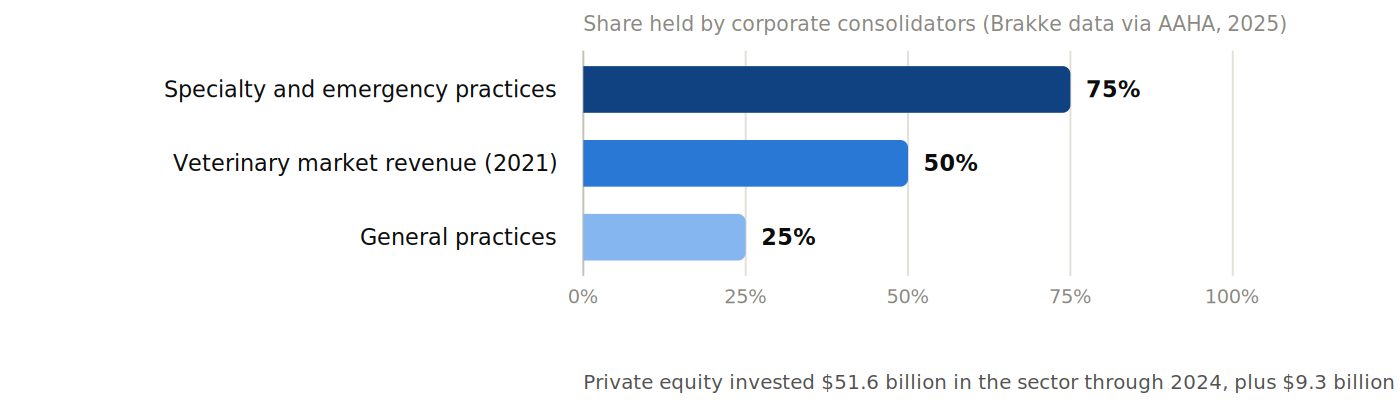
So the rules that were sold as protecting your hometown vet ended up handing her clinic to a corporation. The charity clinic was never her competition. The chain was. The guards were watching the wrong gate, and in late 2025 the U.S. Department of Justice walked into federal court and said, in plain terms, that the AVMA is not allowed to build walls that keep new veterinarians out. Those are the government’s lawyers talking. Not ours.
Rules like these survive in the dark, enforced against scattered people. One horse massage lady at a time. One charity vet at a time. One grandmother with a sick dog at a time. Scattered people lose. People who join together win. The club has been organized for more than 160 years. It is our turn.
1. Join the coalition. NAVEC is an independent nonprofit. We sell nothing, we charge nothing, and we have no gate of our own to protect. We put this record in front of lawmakers, attorneys general, and the press, and we organize the people this system was supposed to serve. Adding your name takes two minutes, and every name makes us harder to ignore.
2. Share this story. Send it to one person who loves an animal. Post it on Facebook. Everything here survives only as long as nobody talks about it.
3. Ask your vet two questions. Kindly, because she is not the enemy. Did you know your association dues help pay for lobbying like this? And would you consider leaving the association, and saying why? Every resignation says what no press release can.
4. Ask your lawmakers for three things. Stop calling the AVMA and the state veterinary association for policy advice as if they were neutral experts; they are the industry. When an animal bill comes up, hear from shelters, pet owners, and independent experts too. And stop filling the state veterinary board from the association’s nominee lists. The referee cannot come from the club’s bench.
Count me in. Add my name. Pet owners, veterinarians, clinic owners, shelter volunteers, farmers. Two minutes. No cost. Every name matters. Read the full story: Illegal to Help The complete investigation, with the charts, the court records, and the money trail. Plus the full 63-page report with all 205 sources, free, as a PDF or right in your browser.What is the AVMA? The American Veterinary Medical Association: a private trade association for veterinary medicine, based near Chicago. It is not a government agency. But its model rules are copied into state law, its allied state associations help pick licensing boards, and lawmakers usually hear from it before voting on animal care.
Is this my vet’s fault? No. Working veterinarians never got a ballot on these policies. AVMA policy is set by about 70 delegates, and members may vote in certain elections “and no other matter.” The same system overworks veterinarians. It keeps clinics from hiring help. And it has pushed most practices into corporate hands.
Why is there no vet near me? America is short tens of thousands of veterinarians, and the federal shortage list is the longest ever recorded: 243 areas across 46 states. NAVEC’s research documents how the organizations that control entry into the profession spent fifty years predicting a surplus instead, while fighting telemedicine, charity clinics, and trained lay vaccinators.
Is it really illegal for a shelter to help my pet? In Texas, shelter veterinarians may generally treat owned pets only for sterilization, or for owners who prove they qualify as poor. In Alabama, charity clinic vets were prosecuted. In South Carolina, a nonprofit’s mobile clinic may not operate within eyesight of a private practice. Each rule is documented in the report.
What can one person do? Share this story, join the free coalition, ask your vet if they know where their dues go, and ask your lawmakers to hear from more than the veterinary association. When people fought back in court, in Texas, Arizona, and Maryland, they won.
Every fact in this article comes from public records: state laws, legislative journals, court rulings, a governor’s veto message, federal agency letters, government shortage lists, and the associations’ own published documents. Each one is cited in NAVEC Report No. 5, Illegal to Help: The Veterinary Lobby’s Invisible Hand, free at the link above. NAVEC does not claim to know what is in anyone’s heart. We read the record, we show our arithmetic, and we are happy to be fact-checked.
← Back to Newsroom