The government inspects trash pickup, restaurant kitchens, and building elevators. No government agency inspects the exam that decides who becomes a veterinarian. A plain-English guide to the VIN News investigation, and what to do about it.
Everyone knows there’s a veterinary shortage, and everyone has a sound-bite answer for it. Almost no one asks the deeper questions: how does America actually decide how many veterinarians there are, and who holds that power? This week, VIN News, the largest and most respected independent news source of the veterinary industry in the U.S. and worldwide, went where those questions lead. The latest installment of its continuing investigation examines one of the private organizations that actually control the supply of veterinarians in America: the company that owns the licensing exam every vet must pass.
Read the investigation: “Latest update on NAVLE audit rankles critics” By Lisa Wogan · VIN News Service · July 30, 2026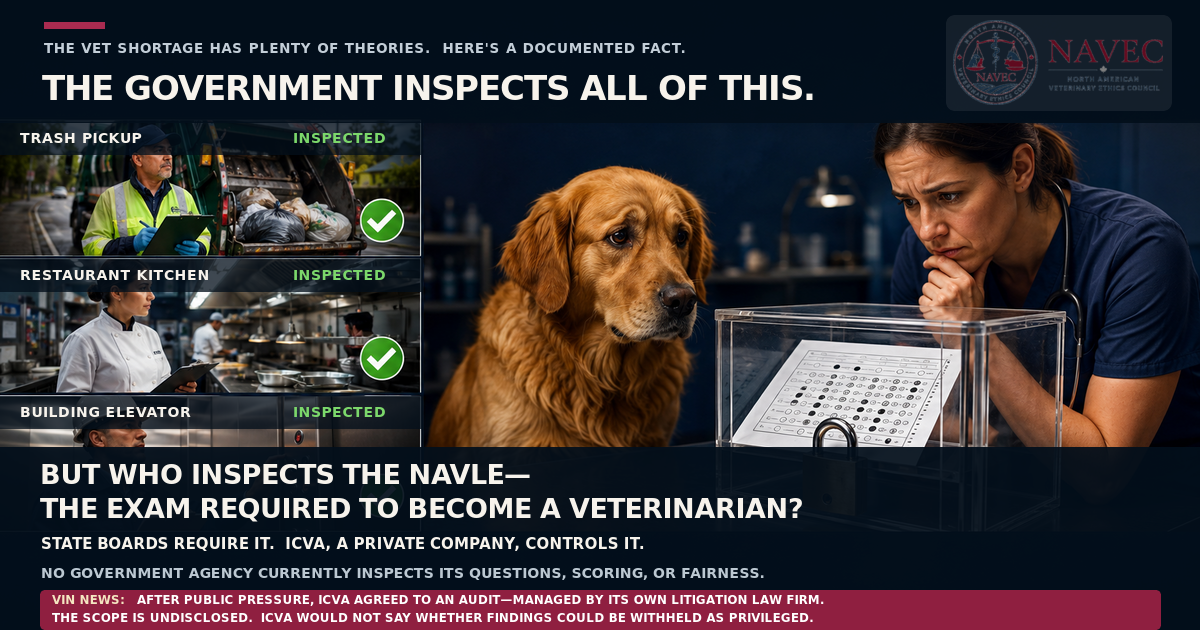
The investigation is the work of veteran VIN News journalist Lisa Wogan, who has followed this story across multiple reports, put hard questions to every party, and printed the answers, and the refusals to answer, for all to see. It also includes a notable analysis by Raphael Moore, VIN’s general counsel, of the oversight structure behind the exam. Our thanks go to Dr. Sarah Lautzenhiser, the Wisconsin practice owner and NAVEC coalition member who put her name on the record before her own state board, and to the veterinary candidates who spoke despite fearing for their careers. That is courage of a different kind. NAVEC was one voice among many: our executive director was interviewed, and we were glad to share our research with a newsroom that verifies everything independently.
The government inspects your trash pickup, restaurant kitchens, the elevator in your building. That’s how the normal world works: when something matters to the public, someone independent is allowed to look.
Now hold that thought against this: to become a veterinarian in America, everyone must pass one exam, the NAVLE. State boards require it. A private company, the ICVA, controls it. No government agency currently inspects its questions, its scoring, or its fairness. And the exam isn’t even the only gate. School accreditation and the certification program for foreign-trained vets are controlled by a private trade association. Every gate that decides how many veterinarians America gets is privately owned, and none is publicly checked.
The allegations range from flawed questions to outright targeting. A formal prelitigation notice described the exam as “potentially anticompetitive, fraudulent, and discriminatory,” citing “pronounced, persistent, and unexplained disparities in NAVLE outcomes related to race and ethnicity.” It named test-takers with Hispanic surnames and graduates of Tuskegee University, the only veterinary school at a historically Black university. As our executive director put it in the article, “the most concrete fairness complaints on the public record are about the actual questions on the exam.” Are the allegations true? Nobody outside ICVA can know, because no one outside ICVA holds the data that could prove them false. That is the scandal inside the scandal.
The exam has never been independently audited. Not once, ever. When VIN News first raised this in December, ICVA’s CEO pointed to a 2020 California OPES review that, she said, “confirmed” the exam “fully met all applicable professional guidelines and technical standards.” California’s own document tells another story. OPES “requested documentation from ICVA” and reviewed the technical reports ICVA chose to send: no exam questions, no scoring records, no outcome data. That’s a home inspection where the seller mails you a brochure. The audit now underway, agreed to only after the allegations went public, is the first time any outside party has even been promised access to the exam itself.
States require the exam but cannot see into it. ICVA collects over $9 million a year from the young vets who take the test, and nothing from the states that mandate it. No contract, no reporting rights, no audit rights.
“This structure creates a predictable oversight gap.”
— Raphael Moore, general counsel of the Veterinary Information Network, in VIN News. Not our words. VIN’s lawyer’s words.
The audit has no stated scope. It is managed by ICVA’s own long-time litigation law firm, which selected the auditor through a request for proposals never made public. ICVA’s CEO told VIN News that ICVA is not involved in any aspect of determining the audit scope. That is offered as reassurance. But you hire an auditor to examine something specific. Here, the company being audited says it doesn’t know what will be examined; the firm that hired the auditor is the same firm that would defend ICVA in court; and when VIN News asked directly whether the findings could be withheld under attorney-client privilege, ICVA declined to answer. That’s not an answer. It’s a question mark with a 2027 delivery date.
While the controversy grew, ICVA gave itself new powers over the people who raised it. In November 2025, eight days apart, ICVA made two moves. The carrot: five fresh exam attempts for every candidate, clearing the slate. The stick: a six-page investigation policy every candidate must sign (which, VIN News reports, replaces a two-page “irregular behavior policy”). Under it, ICVA can punish violations of “the moral norms of the general community.” What does that even mean? No one knows, and that’s the point: ICVA alone interprets it, with no agency or court reviewing the decision, or even knowing it happened. The policy lets ICVA demand “specified documents, data and materials” and interviews “in the ICVA’s sole discretion,” powers a government agency would generally need a subpoena or court order to exercise. And the Candidate Agreement (from the official NAVLE Candidate Handbook) goes further: ICVA reserves the right to cancel scores “before or after the scores are reported” and, read it twice, “without any requirement to demonstrate that I or any other Candidate violated the terms.” A candidate can be barred “indefinitely.” Scores can be canceled “without a refund.” And for an invalidated score, the same agreement has the candidate accept that they have “no right to appeal” ICVA’s decision. No evidence required, no court, no agency, no appeal.
“…without any requirement to demonstrate that I or any other Candidate violated the terms.”
— the Candidate Agreement every NAVLE test-taker must sign. NAVLE Candidate Handbook, Appendix D.
Compare that to what ICVA’s CEO told VIN News this week: that ICVA “would not revoke” a reported passing score. The agreement her own company requires every candidate to sign says otherwise. We don’t want to accuse anyone of lying. We’re just not sure what the polite word is for public assurances contradicted by your own published documents. Meanwhile, an American who invested years of study and hundreds of thousands of dollars in debt can be barred from their state license, not on merit, but on a handful of private employees’ reading of “the moral norms of the general community.” We find that impossible to square with the constitutional foundations this country is built on. The coalition told VIN News what the carrot and stick produced: people “angry and ready to fight one day, suddenly vanish the next day with no explanation.”
And the human cost is on the record: a rural Wisconsin practice owner who searched years for a veterinarian, and the well-prepared young vet she finally found, who failed the exam and cannot learn why.
One private company controls the exam that decides who becomes a veterinarian, including every foreign-educated vet, a critical source for the rural communities hit hardest. The arithmetic is unforgiving. As NAVEC’s research puts it: a five-point drop in NAVLE pass rates cancels out roughly two new veterinary schools’ worth of graduates. Whoever controls that dial controls the supply of veterinarians in America, and nobody is allowed to look at the dial. We are not claiming ICVA has turned it. We are saying something that should alarm you just as much: if it had, no one could catch it.
The CEO’s final reassurance: the auditor “will be given access to any data or documents that they seek.” It sounds comforting. It’s the opposite. An auditor seeks what it was hired to seek, and no one will state, or even claims to know, what that is. It’s a sentence built to end questions, not answer them. Count with us: a paper review presented as an audit; a “would not revoke” assurance contradicted by the signed agreement; an unlimited-access promise with no stated scope. Anyone can misspeak once; we’re all human. Time and time again, in the written record, is hard to call by any polite name.
The stakes here are who gets to practice, and how many veterinarians America has. Against stakes like that, it seems woefully negligent for our elected government to keep looking away: state veterinary boards, state attorneys general, the FTC. VIN’s own general counsel said as much: “If credible concerns arise about bias, audit opacity or chilling of candidate complaints, the board and the Legislature do not have to wait for ICVA to police itself.” Credible concerns have arisen. The waiting should end. (Our quarrel is not with the auditor or the law firm; it is with a structure that asks the public to simply hope.)
It’s easy to share sound bites about corporate greed. It feels good, and no one disputes the high prices driven by profit-hungry investors. But greed doesn’t explain why 344 U.S. counties have no veterinarian at all, not a single one, private or corporate, and why more than 500 counties across 46 states are federally designated veterinary shortage areas. If we’re serious about the shortage, we have to look at who controls the gates, and at the fact that no one is allowed to check them. Fortunately, this is a problem we can solve together. It is hard to imagine these institutions surviving the scrutiny of attorney general investigations unchanged. We live in a country where the government inspects your trash pickup, your restaurant’s kitchen, and the addition on your house. This time, let’s demand an investigation into something that truly demands it: for every pet owner, for the shortage, and for the animals we love.
Demand oversight from your state veterinary board. Ask it in public: what audit rights does this state hold over the exams and accreditations it requires, and will the board request, in writing, the audit’s engagement letter and the full, unedited report, delivered directly to the board? A good answer is a name and a date. Anything else tells you what you need to know.
Add your voice to the call for investigation by every state attorney general, the FTC, and the federal government. That is what these tools exist for.
And share this page with one person who has wondered why they can’t find a vet. It’s the whole picture, with every claim linked to its source.
Our full research: NAVEC Report No. 2, The Gatekeeper No One Can Audit.
Sources: VIN News Service (July 30, 2026 and December 26, 2025); the California Veterinary Medical Board’s published OPES review of the NAVLE (2020); the NAVLE Candidate Handbook 2026–27, including the Candidate Agreement (Appendix D) and the Exam Security Investigation and Appeal Policy (Appendix E); ICVA’s IRS Form 990; and USDA-designated veterinary shortage situations. The 344-county figure is from county-level workforce data shared with NAVEC by academic researchers. Quotations from ICVA officials are as reported by VIN News or as published in ICVA’s own documents.