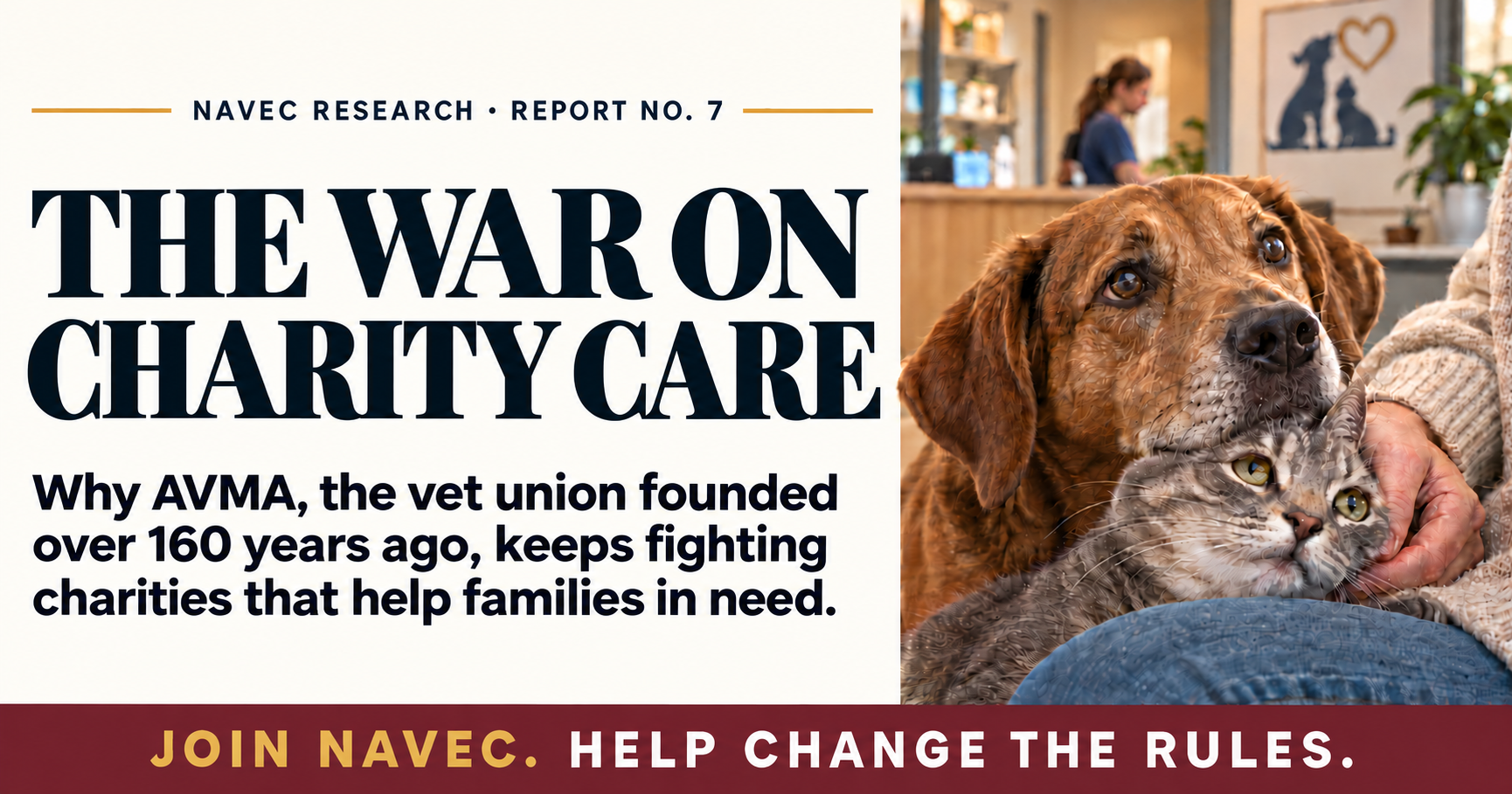
Your pet needs care. You cannot afford the bill. A charity raises the money, and a licensed vet is ready to help.
It should be that simple.
But across the country, the vet union and its state chapters have fought to limit that help.
NAVEC’s new report, The War on Charity Vet Care, follows the American Veterinary Medical Association, or AVMA, its state chapters, and the vet licensing boards they help shape.
The pattern is hard to miss:
- A vet licensing board tried to ban charity clinics from owning medical equipment. Without it, the clinics could not operate.
- That board backed a plan to block even vaccines and flea treatments. Charity vets would have been limited to spay and neuter surgery.
- A state chapter pressured a public shelter to cut care for families’ pets. No new rule was needed.
- Another chapter fought to keep shelter vets from helping more low-income families. Its objection: those families were not poor enough.
Some attempts failed. Others cut off care. The push kept coming.
When public opposition stopped one plan, leaders looked for another route. Restrictions were tucked into a bill about medicine labels. Shelters were pressed to cut services without a public vote.
AVMA promoted income checks before charities could help. It brought state leaders together to discuss competition from charities and share the tactics they had used.
One state chapter put nonprofits on its list of business threats.
A charity helping a sick pet was treated as a threat.
What kind of agenda makes protecting a business more important than helping an animal in need?
The name hides the conflict
The American Veterinary Medical Association sounds like the place to ask what is best for your pet.
It is the vet union. Founded more than 160 years ago, it represents its members’ interests. Its state chapters help set its national policy and carry the fight into state politics.
But states have treated the union’s judgment as the expert guidance behind public rules.
Now look at the crisis
52% of U.S. pet owners have gone without needed vet care.
Families face bills they cannot pay and too few places to turn. How did getting help for a pet become so hard?
The same network that fights charity care helps decide who can become a vet. Here are the three gates.
Three gates.
Who gets to become a vet?
AVMA, the vet union, has a powerful role at each gate.
Who gets to pass?
- AVMA insiders help run the exam gate. ICVA, the International Council for Veterinary Assessment, runs the NAVLE—the national vet licensing exam. Its leadership has deep ties to AVMA.
- Tuskegee’s reported pass rate fell from about 90% in 2018 to 51% in 2024. Founded in 1945, this historically Black vet school trained 70% of America’s Black vets.
- Then AVMA moved to end the school’s accreditation. Tuskegee sued, saying AVMA broke its own rules and denied the school a fair appeal.
- Why did the pass rate fall so far? The public cannot check the exam data needed to test whether the results were fair. ICVA keeps that data private.
- State boards get scores they cannot independently verify. NAVEC’s review finds no independent board access to audit the question bank or scoring records. It documents missing transparency safeguards found in other major professional exams. ICVA also reserves “sole discretion” to cancel scores.
- An “independent audit”—managed by ICVA’s own lawyers. After public pressure, ICVA announced an audit. Its lawyers chose the auditor. ICVA has not released the detailed audit plan or committed to releasing all audit data without invoking attorney-client privilege.
Every state relies on this exam. Why aren’t state boards independently checking the data behind it?
Read NAVEC’s report: Despite Equal Merit →Read NAVEC’s report: The Gatekeeper No One Can Audit →
Who gets to work here?
- AVMA runs the main gate for foreign-trained vets. Its Educational Commission for Foreign Veterinary Graduates (ECFVG) issues the only foreign-vet degree certificate accepted by all 50 states.
- More than 2,000 active candidates. About 250 first-time final-exam seats in 2024. Only about one in four passes on the first try. The program issues around 220 certificates a year.
- Years of waiting. Costs that can top $20,000. NAVEC’s report describes a veterinary specialist who took 12 years to finish the process.
- It promises equal standards, then sets a higher bar. NAVEC documents clinical skills demanded of foreign vets that U.S. schools need not require of their graduates.
- Human medicine opens the door much wider. Its foreign-doctor program issued 13,431 certificates in 2024. Doctors trained abroad make up about one in four U.S. physicians.
Who gets to train more vets?
- AVMA holds the U.S. school-approval monopoly. Its Council on Education is the country’s only vet-school accreditor. New schools must meet its rules.
- Teaching future vets is not enough. The rules also require research. NAVEC’s report explains how those demands make schools harder and more costly to open.
- Tuition brings in just 15% of revenue. Data from the American Association of Veterinary Medical Colleges show average yearly college spending of about $112 million, with about $17 million coming from tuition.
- That leaves roughly $95 million a year from other sources. These budgets include research and hospitals as well as teaching. Imagine trying to open a school with that funding gap.
- The Justice Department warned about this kind of barrier. It says rules for school approval can restrict the supply of vets, raise prices, and leave families with fewer choices.
Read the Justice Department’s warning →
Closed gates mean fewer paths to care.
Help NAVEC change the rules. navec.org/volunteer →
Giving groups that fight competition power over the supply of care puts families and animals last.
We cannot fix a shortage of care while letting those groups keep the doors closed.
Pet owners can change this
For too long, the vet union has had an organized voice that pet owners could not match.
NAVEC—the North American Veterinary Ethics Council—was created to change that. We bring independent experts and pet owners together to open more paths to qualified care.
Our experts examine the rules. Pet owners bring the stories, the neighbors, and the public voice needed to change them.
You can share what happened when your pet needed help. Bring other pet owners into a local chapter. Speak up when your state decides who can provide care.
You do not need a medical degree. You need to care about your pet and be willing to stand with other families.
The vet union has a voice. Your pet needs yours.
Volunteer with NAVEC. Together, we can change the rules. →Tell us your state and how you would like to help. No experience required. No fee to join.Sources behind this article
The full report contains the source record. Key documents:
- South Carolina Code, section 40-69-295(B), and Governor Haley’s veto and the override.
- HumanePro: Caught in the middle—the Alabama clinic closure.
- AVMA’s 2014 account of its nonprofit-care policy meeting, cited in Report No. 7, reference 2.
- Texas Veterinary Medical Association strategic plan and the reproduced May 2023 action alert.
- ASPCA’s account of the rejected Alabama rule.
- AVMA’s own filing describing its founding, membership, and state-association governance.
- Tuskegee’s 2018 rate is attributed in NAVEC’s report to Dr. Crystal Heath’s public account; the 2024 rate is attributed to VIN News. These reported figures are not presented as a verified same-cohort, first-attempt comparison. Tuskegee’s November 2025 lawsuit alleged procedural violations; these are allegations, not a court finding. ICVA denies discrimination. The unpublished fairness data do not establish intentional targeting. NAVEC’s account and source discussion.
- Foreign-doctor certification statistics. Certificates are not licenses. The twelve-year ECFVG example is an individual case, not a typical completion time.
- The three gates graphic draws on NAVEC’s linked reports. ICVA means International Council for Veterinary Assessment; NAVLE means North American Veterinary Licensing Examination; ECFVG means Educational Commission for Foreign Veterinary Graduates. The school figures are NAVEC’s analysis of American Association of Veterinary Medical Colleges (AAVMC) data; they describe total college spending, including research and clinical operations, not the cost of teaching alone.
- ICVA’s audit announcement names Dorsey & Whitney as process manager and ACS Ventures as auditor. It states broad validity, reliability and fairness goals and promises independent findings. In VIN’s July 30 interview, the CEO said findings would be public and the auditor could access requested data. She did not answer whether attorney-client privilege might shield findings. The detailed audit request for proposals remains unpublished. NAVEC’s linked report supplies the comparison with other professional exams and its assessment of the state-board verification gap. This concerns routine independent oversight, not a claim that courts or government agencies lack compulsory legal powers. ICVA’s candidate agreement reserves sole discretion to invalidate scores when it has a reasonable basis to question validity; this is not evidence of arbitrary alteration of scores.
- ICVA’s CEO and AVMA’s foundation; ICVA’s score and appeal policy.
- The licensing-exam organization’s governance and AVMA’s presentation on its foreign-graduate pathway.
- The proposed limits on charity-clinic drugs and equipment, also documented in Report No. 7, reference 10.
- Texas licensing requirements and NAVEC’s research on veterinary school approval and foreign-trained veterinarians.
- The 2025 Gallup–PetSmart Charities finding that 52% of U.S. pet owners skipped or declined needed veterinary care.
Terminology follows NAVEC’s report. “Vet union” describes AVMA’s role representing the profession; it is a professional membership association. “State chapters” refers to the separately incorporated state associations whose delegates help set AVMA policy.