America is short 37,000 veterinarians. Your vet is booked out for weeks; shelters can’t hire; a third of pets go unseen. Meanwhile, thousands of fully trained veterinarians — many of them U.S. citizens — are begging for permission to work. The gate they must pass through is owned by the trade association of the veterinarians already here. It has spent fifty years insisting America has too many vets. And no one — no state, no federal agency, no auditor — is allowed to check how it runs the door.
Dr. Lina Cortés has been a veterinarian for eleven years. She is an American citizen. She passed the national veterinary licensing exam — the same one every U.S. vet school graduate takes — in 2024. She wants to treat horses and farm animals, the corner of veterinary medicine everyone agrees is desperately short-handed. And she is not allowed to practice.
For two years, she checked a registration portal three times a day — morning, lunch, night — hoping for a seat at one final exam. In her words: “There was never an opening.” So she did something extraordinary: she emailed every senator in Virginia, found a sponsor, and helped pass a law — unanimously, in both chambers — to let veterinarians like her work under supervision while they wait. Days before it took effect, the state told her the paperwork could take two more years.
“It honestly feels like the light at the end of the tunnel keeps getting pushed farther away,” she told the veterinary press. While she waits, an eleven-year veterinarian works as a veterinary assistant — a job that requires no degree at all.
Her story is not a glitch. It is the system working exactly as built. And once you see who built it, the rest of this story makes a terrible kind of sense.
Every veterinarian trained outside a small list of accredited schools — including American citizens who studied abroad — must earn a certificate before any state will license them. That certificate is issued by a program called the ECFVG, and here is the part most people can’t believe: the ECFVG is owned, staffed, and run by the American Veterinary Medical Association — the private trade association of the veterinarians already in the market. Not a government agency. Not an independent body. The incumbents’ own club runs the door their future competitors must walk through.
And nobody elected them to do it. The AVMA speaks for veterinary medicine to America — to Congress, to state legislatures, to the press — but its gatekeeping bodies are appointed from within, beyond the reach of its own ordinary members’ votes. The U.S. Department of Justice, in a 2025 federal court filing, described the structure of the AVMA’s school-accrediting council: appointees of the AVMA and the deans’ association, plus public members the council selects itself, all housed within and staffed by the AVMA. Working vets don’t control it. Pet owners certainly don’t. It answers, in practice, to no one.
What does that unaccountable door look like in numbers? Like this:
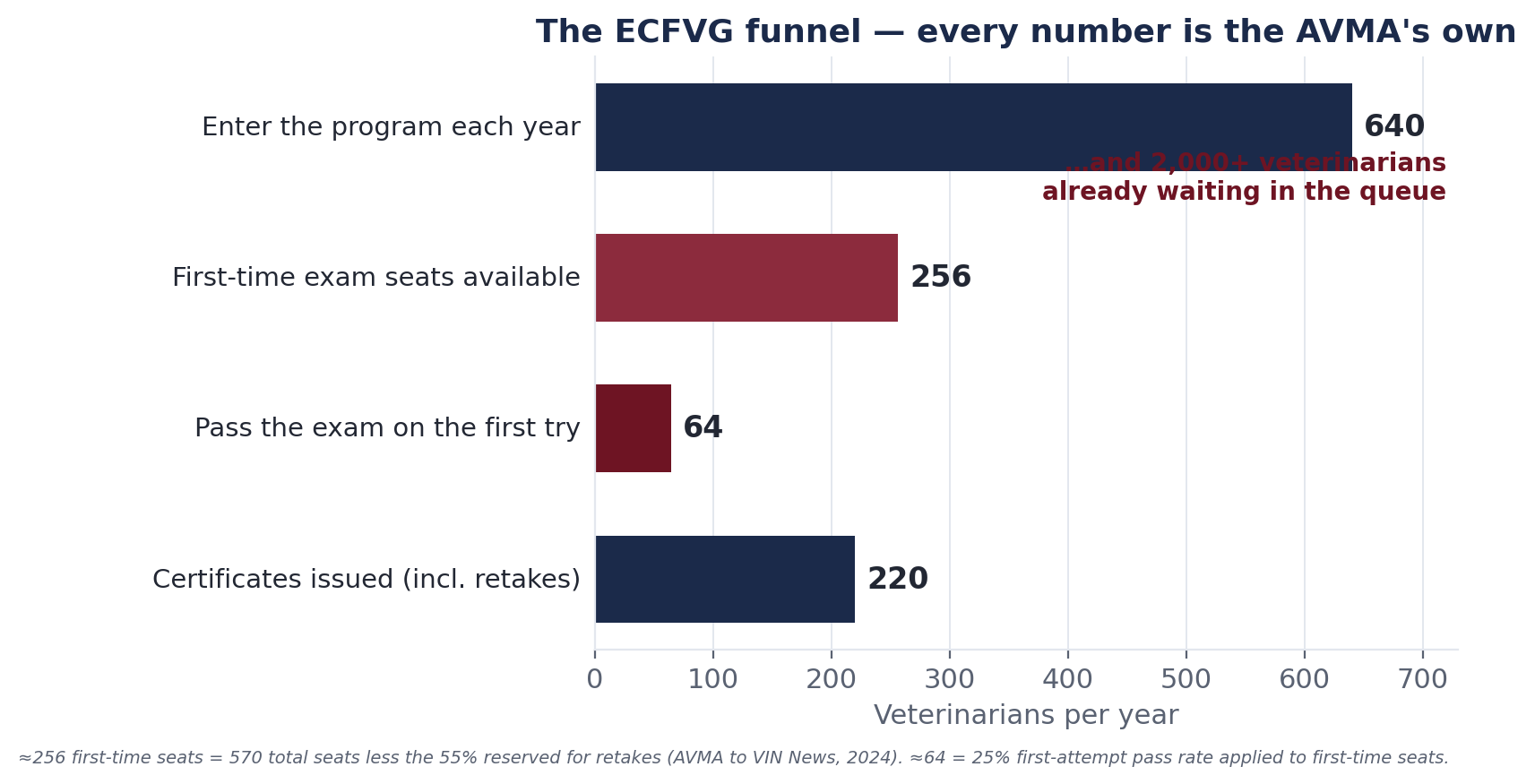
American vet-school graduates take a multiple-choice test and are done. No hands-on exam. Ever. The foreign-trained face something else entirely: a three-day, seven-station practical on live animals — anesthesia and a solo dog spay graded pass-or-fail on the spot, plus horse and cattle stations that most American vets, who overwhelmingly treat cats and dogs, would face just as cold. It costs $12,804, nonrefundable for any reason — including a candidate whose travel visa is denied. Fail one station, and the retake is $4,571 per section, if you can find a seat in time.
How hard is it? Dr. Mariana Pardo trained at Cornell and works as a board-certified critical-care specialist in New York — she saves animals other vets can’t. She failed the anesthesia station twice; the second time she was removed from the exam over a forgotten alcohol wipe. Her journey through this program took twelve years — she finished it long after she was already a specialist.
“If a specialist who’s been trained in the U.S. can’t pass this test, I can only imagine how hard it is for someone who has just stepped on U.S. soil.”
— Dr. Mariana Pardo, VIN News, 2024
Don’t take her word for it. A veterinarian who passed the exam and admires it reported in the profession’s own press that the exam’s own examiners doubt “that many entry-level graduates from AVMA-accredited programs could pass the CPE immediately upon graduation.” Read that again: the people who grade the test don’t think America’s own vet graduates could pass it. It is not a competence check. It is a wall — reserved for exactly the veterinarians we are shortest of.
Why would anyone build a door like that? Here is where the story turns black and white. For fifty years, the AVMA has commissioned study after study of the veterinary workforce — and for fifty years those studies have found the same thing: too many veterinarians coming. Every forecast that could be tested against reality failed. Every one failed in the same direction. Its current outlook still projects a surplus of veterinarians by 2030 — published while clinics cut hours and a third of America’s pets go unseen.
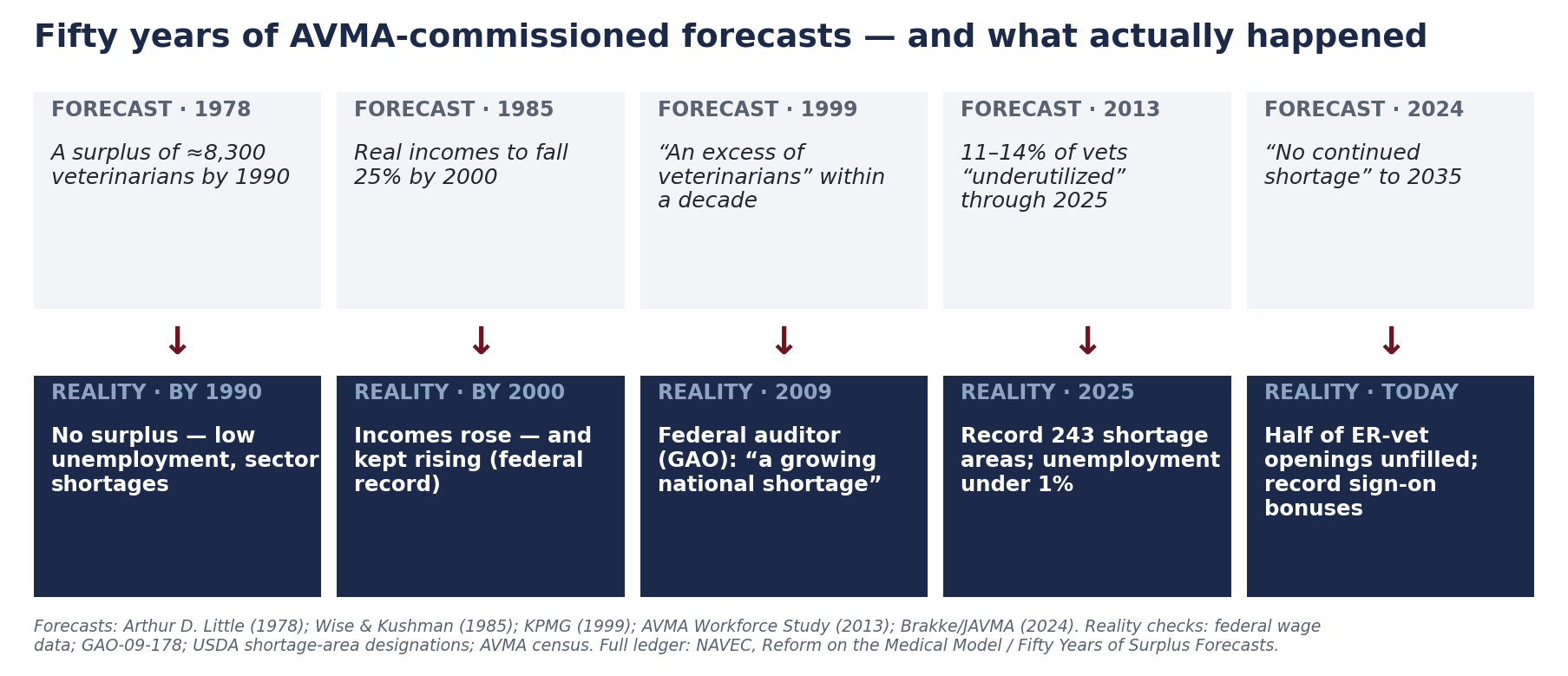
A coin that comes up tails fifty times in a row is telling you something about the coin.
If the fifty-year record were an honest mistake, you would expect the AVMA to welcome help. Look instead at what happens every time anyone, anywhere, tries to widen access to veterinary care.
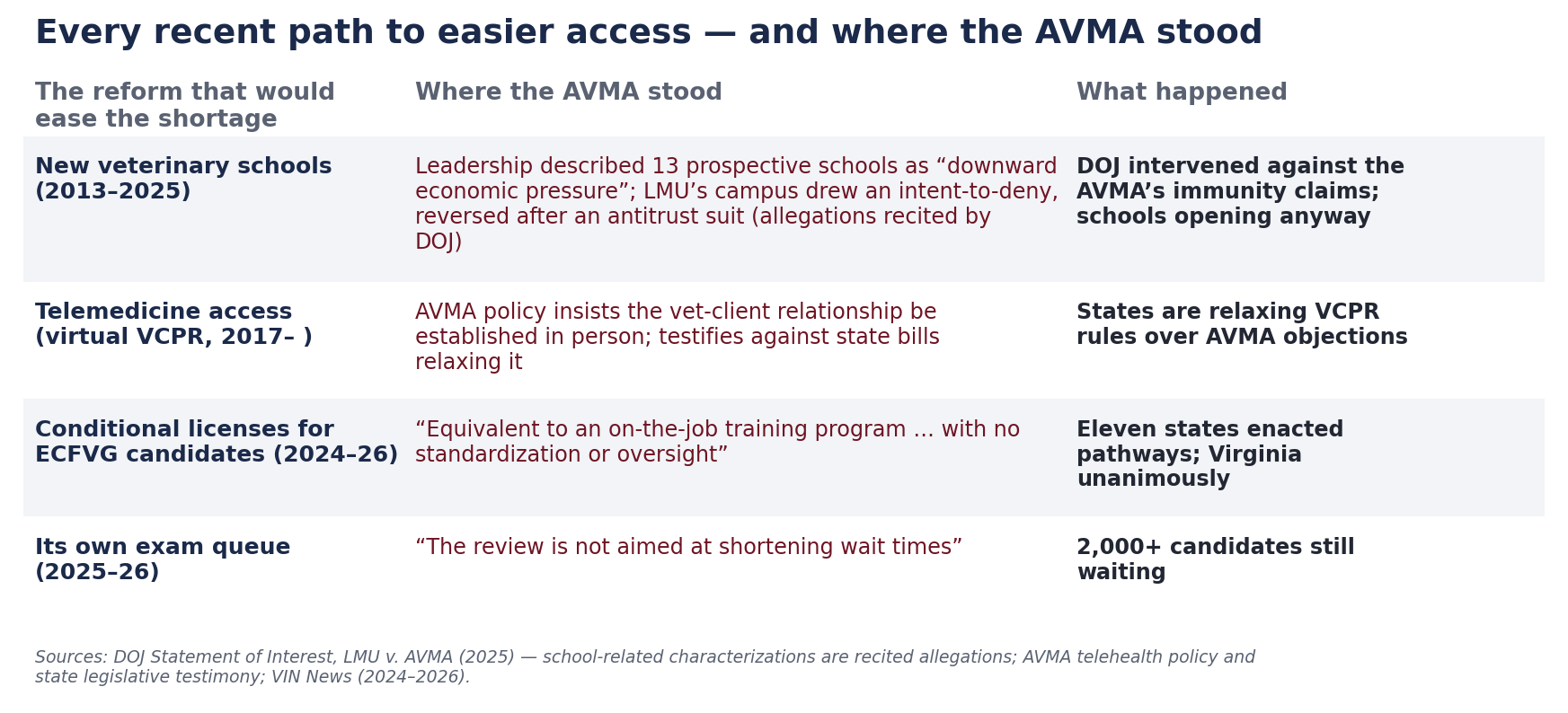
When states tried to let vets see patients by telemedicine — a lifeline for rural families an hour from the nearest clinic — the AVMA’s policy said no, and its letters went to legislatures. When eleven states passed laws letting stranded, fully trained veterinarians work under supervision, the AVMA dismissed the model as having “no standardization or oversight” — this from the organization that runs the only unsupervised gate in American veterinary licensure. And when it finally announced a review of its own bottleneck exam, its chief of academic affairs said the words that give this whole story away:
“The review is not aimed at shortening wait times.”
— AVMA chief of academic affairs, VIN News, 2026
Two thousand careers in a queue, and the fix isn’t aimed at the queue.
Pet owners pay — in weeks-long waits, hour-long drives, bills inflated by scarcity, and the cruelest arithmetic in veterinary medicine: euthanasia chosen because affordable care couldn’t be found. Working veterinarians pay — the AVMA’s own members are burning out and closing shifts short-staffed while their association fights the reinforcements. And the animals pay — a third of American pets go unseen each year, while shelter dogs are spayed and anesthetized on the exam’s own tables, in a hands-on test the profession’s domestic standard doesn’t consider necessary for anyone else.
Human medicine looked at this exact problem and solved it decades ago: foreign-trained doctors take the same exams American medical students take, run by an independent body the AMA does not control, under federal oversight — 13,431 certified in 2024 alone, and today one in four American physicians trained abroad. If we trust that system for the doctors who treat your children, someone should have to explain why dogs and cats get a private club instead.
Here is the truth about how gates like this one survive: not because anyone defends them well, but because the people harmed by them are scattered. A candidate refreshing a portal alone at midnight. A pet owner who assumes the six-week wait is normal. A rural family that quietly stopped calling the vet. A burned-out clinician who thinks she is the only one drowning. Scattered people lose to organized institutions every single time — organization is the club’s entire advantage.
But look at what even scattered people have already done. Dr. Cortés, alone, got a law passed unanimously. Eleven states have opened supervised-practice doors. New York licenses foreign-trained vets through its own pathway — that is how Dr. Pardo practices today. The Department of Justice has walked into federal court. Every crack in the wall so far was made by someone who decided not to wait for permission. Now imagine those people — and everyone reading this — pushing in the same direction at once.
That is exactly what NAVEC was built for. We are an independent nonprofit — no exam fees to protect, no members-only interests, no gate of our own. We do the research the gatekeepers won’t publish, put it in front of state attorneys general and legislatures, and organize the people this system was supposed to serve: pet owners, veterinarians, shelters, farmers, and the candidates stuck in the queue. Reform, not revolution — but reform that actually arrives.
The AVMA has a century of organization behind it. The rest of us have the numbers, the record, and now the receipts. The only remaining question is whether we show up together — because no one is coming to fix this for us, and as this report proves in thirty-nine documented pages, the gate will not open itself.
Join NAVEC — add your voice to the coalition Pet owners, veterinarians, shelters, farmers, students, lawmakers: it takes two minutes, and every name makes the next AG letter, the next statehouse hearing, and the next headline harder to ignore. Together is the only way this has ever worked. Read the full report: The Veterinarians America Won’t License 39 pages. Every claim sourced to public records — most of them the AVMA’s own documents, statements, and filings. Charts, case files, and the complete legal analysis. Share it with one person who loves an animal.Why is there a veterinarian shortage? America is short roughly 37,000 full-time vets, heading to 83,000 by 2031 — and the fastest fix, veterinarians already trained abroad, is throttled by a gate that certifies only 150–220 of them a year.
What is the ECFVG? The AVMA-owned certification program nearly every state requires of foreign-trained veterinarians — including U.S. citizens who studied abroad. No government body audits it.
Don’t foreign vets take the same exam as U.S. graduates? They take the same written exam — plus a $12,804, three-day, live-animal practical that no American graduate has ever been required to pass. In human medicine, foreign-trained doctors simply take the same USMLE as everyone else.
What can I do? Join the coalition below, share the report, and ask your state legislators and attorney general to look behind the gate.
All facts in this article are drawn from public records and are fully cited in the report linked above, including the AVMA’s own program bulletins and statements, VIN News investigations (2023–2026), Today’s Veterinary Practice, state legislative records, and the U.S. Department of Justice’s Statement of Interest in Lincoln Memorial University v. AVMA (characterizations from that filing are recited allegations and legal positions, not adjudicated findings). Quotations are reproduced verbatim from the cited sources. NAVEC does not assert any person’s or organization’s intent; readers are invited to review the record and draw their own conclusions.
← Back to Newsroom