You call the vet. The next opening is three weeks away. Or the bill is more than you have.
It is not your fault. It is not your vet’s fault either.
So why is it this hard? Look at what just happened in Texas.
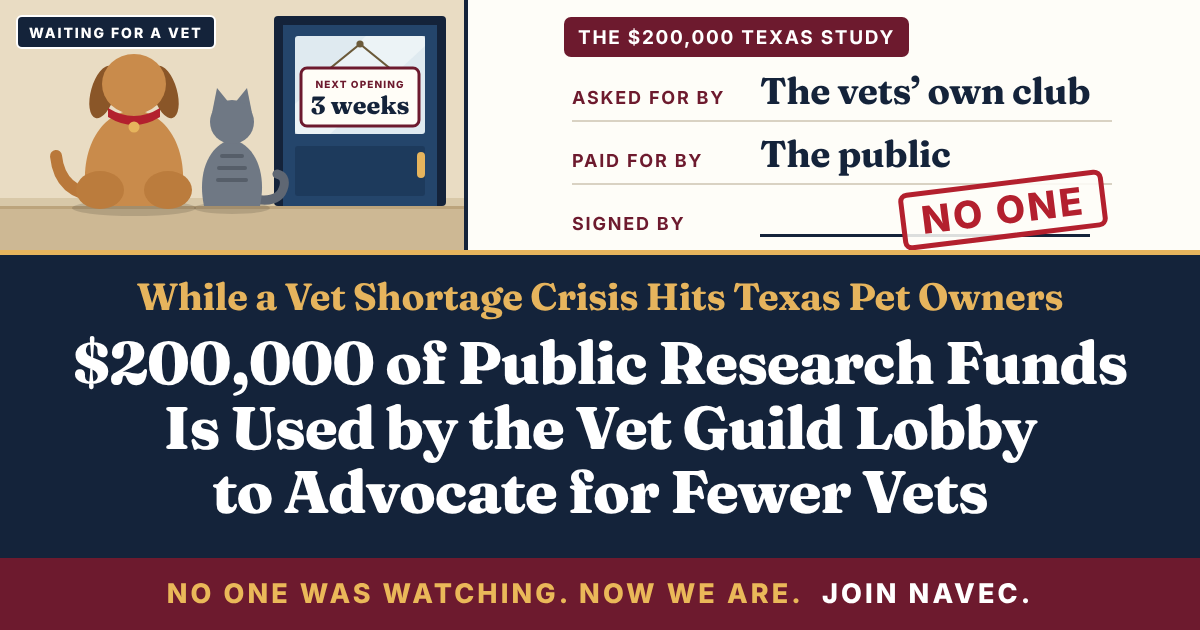
The club asked. The public paid.
Vets have a club. Its Texas chapter is the Texas Veterinary Medical Association. Its job is to look after vets who are already in business.
In 2025, the head of the Texas club told lawmakers that a massive vet shortage was a false idea. Then he asked the state to pay for a study.
Eight days later, a request for $200,000 of public money was written up.
The study went to a state board in November 2026. It says Texas will have enough vets for ten more years. The club called it “good news.”
No author is named. Nobody signed it.
So we checked the math
We are NAVEC, the North American Veterinary Ethics Council. Our head of research is an economist. He read all 48 pages. Then he wrote a report of his own. Here is what he found.
- It counted licenses, not vets at work. The study says Texas has 11,449 vets. That is a count of licenses. But 1,364 of those vets work in other states. That is about one in eight.A license does not show if a vet still works, or how many days a week. In 2018, more than one in four licensed Texas vets was already over 60. Each of them is over 68 now. The study counted every license as one full-time vet.
- Its own pages do not agree. Up front, the study says 11,449 vets practice in Texas. In the back, on page 37, it uses the state labor office’s number for the same year. That number is about 8,800.
- It never counted one open job. That same week, the state’s own job site listed 422 open vet jobs. It listed 33 people looking for one. That is 13 jobs for each person. The study does not count one open job. Not one waiting list. Not one price. Not one shelter.
- It counted on vets who may never come. The plan needs about 650 vets to move to Texas from other states. Every year. The study counts vets who move in. It has no line for vets who move away. It never tested what happens if fewer come.
One mistake is a mistake. Four mistakes that all lean the club’s way are something else.
Good enough for your doctor. Not allowed for your vet.
Lawmakers gave the study five things to look at. All five were about vet schools and a loan program for country vets.
On its last page, the study goes further. It rules on a question nobody asked. It says Texas needs no new kind of provider for at least ten years. It shows no research on that.
Now compare vet care with your own doctor’s office.
- Schools. America has about 200 medical schools and about 40 vet schools. Texas has 16 medical schools and 2 vet schools. A 2016 state report said Texas needed no new vet school. Lawmakers opened the second one anyway, and Texas is still short. Now the new study says the schools we have are enough.
- Nurse practitioners and PAs. At your doctor’s office, a nurse practitioner or a physician assistant (PA) can examine you, treat you and write a prescription. That takes a load off the doctor. Vet care in Texas has no job like that. This is the “new kind of provider” the study says Texas does not need.
- Video visits. Your doctor can see you by video. In 2025, two Texas bills would have let a vet start care the same way. Neither passed.
The club told its own members why it wanted this study. Lawmakers were hearing that two changes would ease the shortage: a job like a nurse practitioner or PA for animal care, and video visits with a vet. The club called those bills bad. It wanted new numbers on the record before the next fight.
Now it has them. If there is no shortage, the club can call every fix unneeded: more schools, nurse practitioners and PAs, video visits, charity clinics.
Add it up. Each answer means fewer vets and less care for your pet. That is how $200,000 of public money ended up making the case for fewer vets.
What Texas really looks like
- In Midland, a clinic offered a new vet a $150,000 bonus just to sign on. The ad ran on the club’s own job board.
- In Houston, one clinic has had the same ad up for a vet since 2021.
- In Austin, a shelter vet told a TV station about owner after owner giving up a cat with a blocked bladder. It can be treated. They could not pay.
- At Texas A&M’s job fair this fall, 142 employers signed up to hire vets. The school’s class is about 180. About 120 are likely to stay in Texas.
Who ran that job fair? The school on the study’s cover and the club that asked for the study.
Our report estimates that Texas is about 3,300 vets short today. By its count, Texas pets miss about 7 million vet visits a year.
Would you trust this referee?
Picture a ball game. One team asks for the referee. The fans pay him. He rules for that team. And he has no name on his shirt.
That is what a corrupt system looks like. And it is how vet care is run today.
Since 1978, the national club has put out study after study saying America has enough vets, or too many. Today the federal government lists vet shortage areas in 46 states.
Most vets are good people. Your own vet never got a vote. The trouble is a system where one side makes the rules and no one is watching.
So we are watching
That is why we started NAVEC.
We do the homework, independent of the club. And we put a name on our work.
We also have each other. People in more than 40 states have signed up. We ask to see the records. We tell our stories. We show up where the rules are made.
One pet owner is easy to ignore. Thousands are not.
In Texas, we are asking for three things. Show who wrote the study. Check how the $200,000 was spent. Do a real study, with names on it.
This time it was Texas. The club has a chapter in every state.
Every animal deserves a vet. Every family deserves care it can afford.
Count me in. Add your name. It takes one minute. A real person from NAVEC will reach out with a first small step in your state.
Read NAVEC’s full report on the Texas study → Report No. 8: the open jobs, the count of animals, the problems with the study’s math, and the public record of how the study came about.NAVEC was started by volunteers. We take no money from corporate vet chains or private equity. Small monthly gifts from people like us pay for the work. Become a founding member from $7 a month.
Where the facts come from: the numbers in this article are in NAVEC Report No. 8, which cites each one to a public source or to the study itself. The two counts in point 2 are on pages ii and 37 of the study. The club is our name for the American Veterinary Medical Association and its state chapters. They are private trade associations, and the Texas chapter is the Texas Veterinary Medical Association. A job like a nurse practitioner or PA is what the report calls a midlevel practitioner: a trained provider who works under a veterinarian, the way a physician assistant works under a doctor. School counts: the Liaison Committee on Medical Education listed 165 M.D. programs on November 13, 2026, 13 of them in Texas. Osteopathic medical schools add about 40 more, 3 of them in Texas. The American Veterinary Medical Association’s accrediting council counted 37 U.S. vet schools in November 2025, and a few have opened since. Doctors may begin care by live video in every state, as covered in NAVEC’s report Illegal to Help. The count of states where people have signed up is from NAVEC’s sign-up list on November 16, 2026. NAVEC’s shortage figures are estimates, and the report shows the arithmetic. The public record does not show who wrote the study, and NAVEC does not claim to know. NAVEC is happy to be fact-checked and corrects the record when shown better evidence: info@navec.org.
← Back to the newsroom