Manipulation of the labor market abounds in the market for pet care.

One of the nation’s leading scholars of occupational licensing, with two decades of peer-reviewed research relied on by state legislatures and federal regulators. Founding director of the Knee Regulatory Research Center and affiliate at Columbia University’s School of Nursing. Full bio →
Six years ago, my coauthor Robert Orr wrote an insightful piece carefully documenting the planned reduction in the number of physicians orchestrated by the 1981 report by the Graduate Medical Education National Advisory Committee (GMENAC). Pictures speak a thousand words, and here is one of the more impactful graphs from Robert’s report:
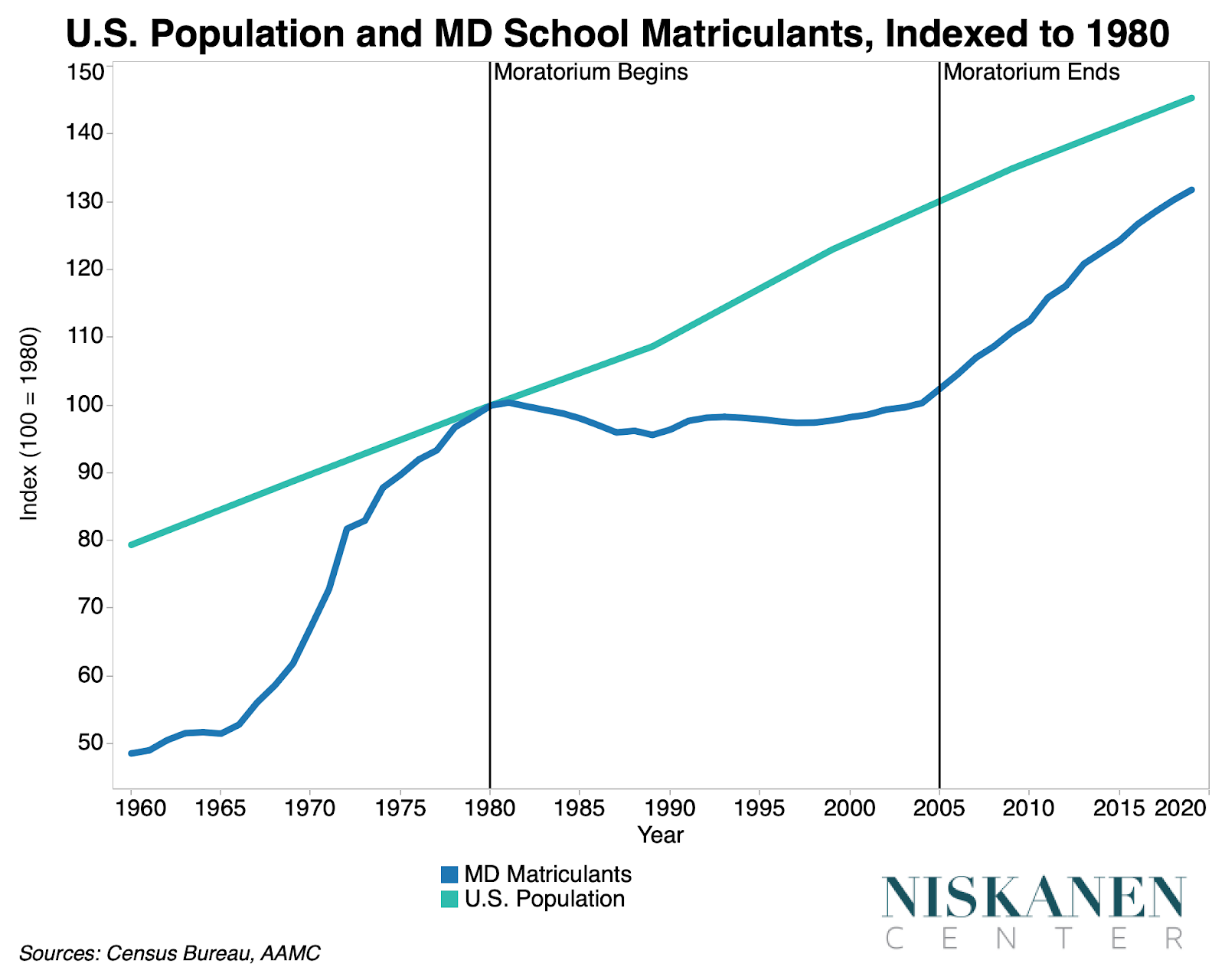
The moratorium on new medical schools, in line with the narrative of a projected physician surplus, significantly reduced the number of medical school graduates. We are still experiencing the negative effects of this poor planning today. Is there any evidence of something like this in other licensed professions?
It turns out that something very similar happened with veterinarians. A report by NAVEC — the North American Veterinary Ethics Council — documents almost 50 years of projections of a national surplus of veterinarians:
Source: The Gatekeepers and the Gate — NAVEC Report No. 4
Instead of simply relying on the marketplace — the undisputed winner when it comes to balancing supply and demand — the American Veterinary Medical Association (AVMA) significantly revised licensing requirements. One example is the introduction of the North American Veterinary Licensing Examination (NAVLE) in 2000, which replaced previous exam options for veterinarians.
Also, much like the moratorium on new medical schools in the U.S. after 1980, a similar freeze occurred for veterinary schools. This thoughtful article provides the full history:
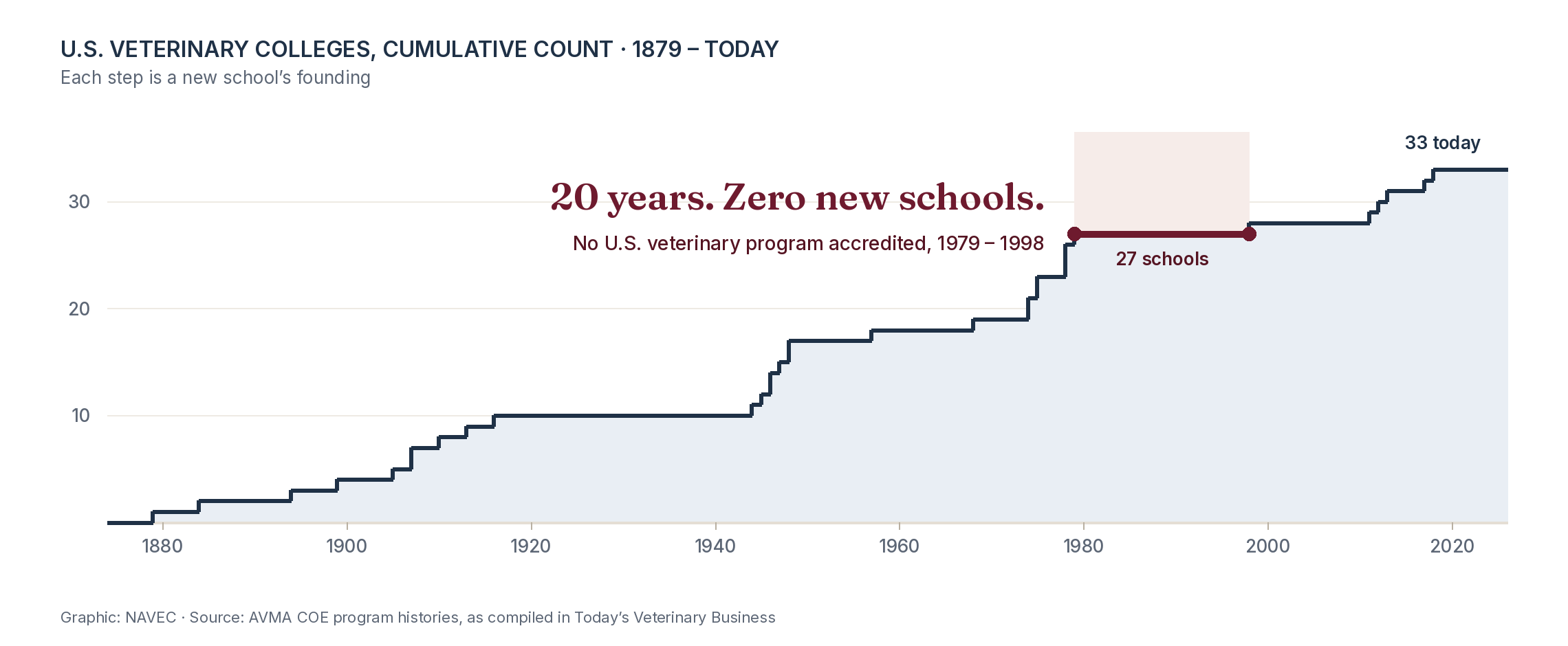
Established, late 1800s: Cornell (1894), Iowa State (1879), Penn (1884), Washington State (1899).
Established 1905–1957: Auburn (1907), Colorado State (1907), Kansas State (1905), Michigan State (1910), Ohio State (1913), Oklahoma State (1948), Purdue (1957), Texas A&M (1916), Tuskegee (1945), UC Davis (1948), Georgia (1946), Illinois (1944), Minnesota (1947), Missouri (1946).
Established 1968–1979: LSU (1968), Mississippi State (1974), NC State (1978), Oregon State (1975), Tufts (1978), Florida (1975), Tennessee (1974), Wisconsin (1979), Virginia-Maryland (1978).
Established 1998–2018: Western University of Health Sciences (1998), Lincoln Memorial (2011), Midwestern (2012), Arizona (2013), Long Island (2017), Texas Tech (2018).
With no new programs receiving accreditation from 1978 to 1998, it is no wonder that today we are facing a shortage of veterinarians. Taken together with a centrally controlled exam that better enabled adjustment to a perceived surplus, we are faced with today’s challenges.
Instead of granting veterinarians the power to manipulate supply like a cartel, the market would benefit from more competition. Take this insightful quote from a licensed veterinarian:
I have observed that almost all, if not all, previous reports analyzing the veterinary workforce — at least all that I can remember — concluded we have too many veterinarians, whether expressed as oversupply, excess output or another description. In retrospect, each study was shown to be erroneous… The demand for veterinary education by aspiring students and the demand for what veterinarians are trained to offer remain exceptionally high. We need more veterinarians, and new programs will help existing schools address the needs now and into the future.
Source: Today’s Veterinary Business
I am always reminded by statements like this to separate the viewpoints of individual veterinarians from the viewpoints of the associations a.k.a. cartels.
Here are some possible options to help alleviate the veterinarian shortage.
1. Expedite accreditation for new veterinary programs. According to the account of the author above, 11 schools in the U.S. mainland and Puerto Rico are seeking accreditation. More schools that produce more veterinary graduates will help ease the supply bottleneck.
2. Introduce competition into the exam marketplace. A single licensing exam with limited oversight is the recipe for market manipulation. Alternative means of assessing competency should be considered. At the very least, states should audit the NAVLE and make sure that it is properly balancing public safety with consumer needs.
I was very surprised to observe a similar history for veterinarians and physicians. Much credit to Robert Orr for his great work in identifying the issue for physicians; the veterinary record is carefully documented in NAVEC’s research. Both examples demonstrate the problem of central planning and misaligned incentives of regulators.
Read the research behind this commentary → “The Gatekeepers and the Gate” — NAVEC Report No. 4, documenting fifty years of surplus forecasts and the structures that control entry to the profession.Edward Timmons, PhD, is NAVEC’s Head of Research and one of the nation’s leading scholars of occupational licensing. This commentary draws on published studies and public records cited in the text; characterizations reflect the author’s analysis. Read Dr. Timmons’s full bio →
← Back to the Newsroom