Research

Research & Reports

The evidence behind the case. NAVEC's research rebuilds the veterinary workforce question from primary data — animal populations, standards of care, and the profession's own figures — and assembles the public record on competition in veterinary education and licensing. Every load-bearing number is sourced and citable.

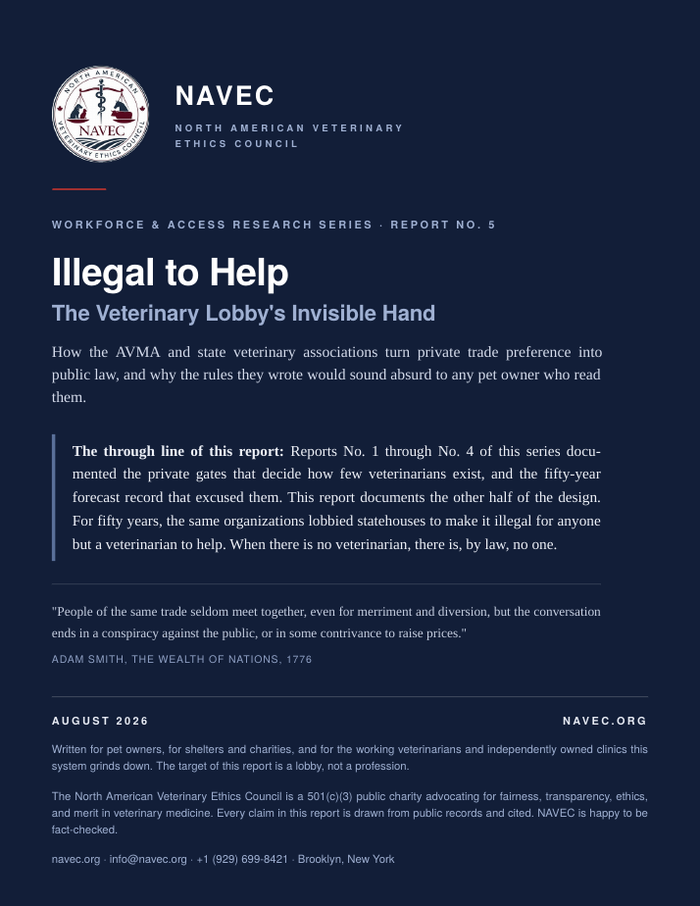
Cover of Illegal to Help: The Veterinary Lobby's Invisible Hand, NAVEC Workforce & Access Research Series, Report No. 5
Investigative Study · Report No. 5

Illegal to Help

The Veterinary Lobby’s Invisible Hand: how the AVMA and state veterinary associations turn private trade preference into public law

NAVEC · August 2026 · 63 pages · 12 charts · 205 sources · PDF + web

A pharmacy technician can give your child a flu shot in all fifty states. In Texas, a trained shelter worker who gives your dog a rabies shot is breaking the law unless a veterinarian stands on the premises. This report documents who writes rules like that and how: the model practice act “intended for use in state statute,” the regulator lists handed to governors, and eight case files, from lay rabies vaccinators to telemedicine to the $2.4 million campaign against Colorado’s voters, drawn from the public records of more than twenty states, the District of Columbia, and Congress. With the independent clinic file: how the same program starves private practices of staff and leverage while scarcity fattens the consolidators buying them out, and why the charity clinic was never the threat. Ends with the counter-campaign and the legal remedies already on the table, from NC State Board of Dental Examiners v. FTC to the Justice Department’s December 2025 filing.

94.6%of the $2.4M campaign against Colorado’s midlevel ballot measure came from the AVMA itself
39 of 51U.S. jurisdictions bar a veterinarian from starting care by video call
52%of pet owners skipped or declined needed veterinary care in the past year
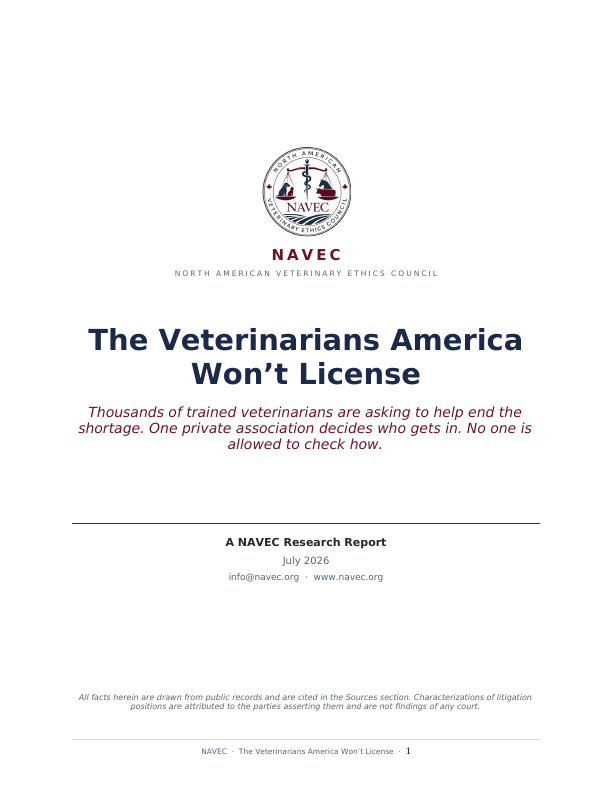
Cover of The Veterinarians America Won’t License — NAVEC research report on the ECFVG and the veterinary shortage, July 2026
Investigation · Foreign-Trained Veterinarians

The Veterinarians America Won’t License

The ECFVG, the Clinical Proficiency Examination, and the shortage’s fastest remedy — held behind a gate no one may audit

NAVEC · July 2026 · 39 pages · 9 charts · PDF

America is short roughly 37,000 veterinarians while more than 2,000 fully trained candidates — many of them U.S. citizens — wait years inside the AVMA’s own certification program: about 256 first-time exam seats a year, a 75% first-attempt failure rate, total costs doubled in 2026 without published justification, and no federal, state, or independent audit of any kind. Built entirely on public records: the AVMA’s own bulletins and statements, VIN News investigations, state materials, and the U.S. Department of Justice’s filing in LMU v. AVMA. With the fifty-year forecast ledger, the opposition ledger, case files, impact estimates, and a complete legal exposure map.

256First-time exam seats per year, nationwide — against 2,000+ enrolled candidates
61×Medicine certifies foreign-trained doctors at 61 times the veterinary rate
$12,804Nonrefundable exam fee — no U.S. graduate has ever been required to take it
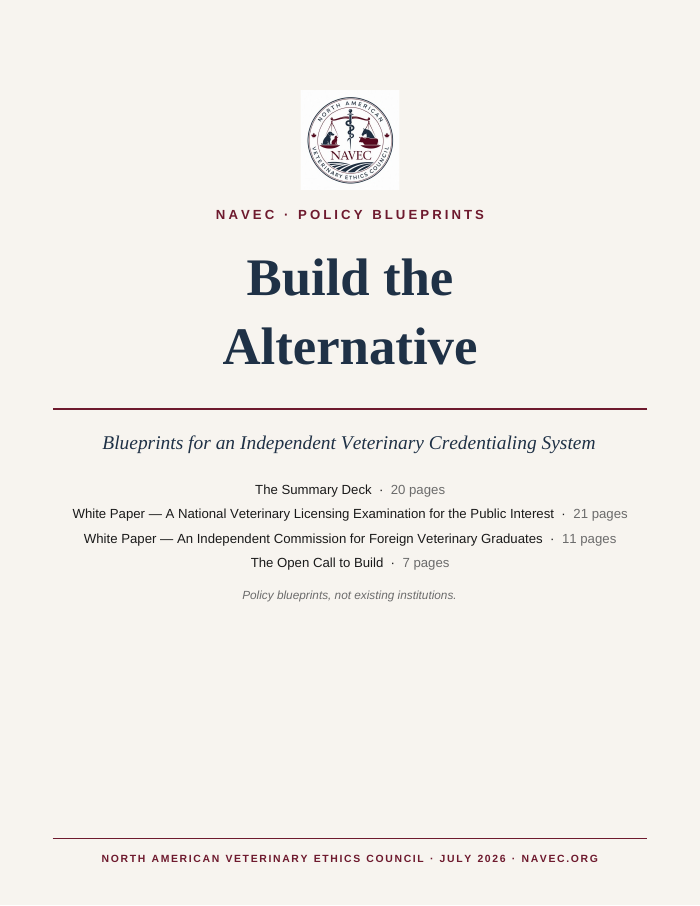
Cover of Build the Alternative — Blueprints for an Independent Veterinary Credentialing System, NAVEC, July 2026
Policy Blueprints · Build the Alternative

Build the Alternative

Blueprints for an Independent Veterinary Credentialing System

NAVEC · July 2026 · 4 documents · 59 pages · PDF

A complete construction plan for the alternative: an independent Examination Council governed by the state licensing boards on the nursing model, and an independent Credentials Commission for foreign-trained graduates on the model medicine has used since 1956. Governance, bylaw obligations, item development, security, budgets, fees, three adoption pathways, and the continuity plan under which licensure proceeds uninterrupted on any timeline. Blueprints, not institutions: NAVEC holds no seat, veto, contract, or financial interest in what is proposed.

4Documents — a 20-page summary deck, two white papers, and the Open Call to Build
$450–495Published launch fee (est.) vs. the NAVLE’s $825 (2026–27)
9–12 moDefault build to first administrations — six at the emergency minimum
Cover of The Gatekeepers and the Gate, NAVEC Integrity & Accountability Research Series, Report No. 4
Investigative Study · Report No. 4

The Gatekeepers and the Gate

How a Half-Century of Surplus Forecasts and Control of the Licensing Gate Built the Veterinary Shortage

NAVEC · June 2026  ·  19 pages  ·  PDF

Two private organizations stand between a veterinary student and a license to practice: the AVMA Council on Education, the sole federally recognized accreditor of veterinary colleges, and the ICVA, which owns the single examination every U.S. and Canadian jurisdiction requires for licensure. This study assembles, for the first time in one place, a fact the public record can carry on its own weight — that the institution controlling the accreditation half has, for roughly fifty years, repeatedly forecast a surplus of veterinarians, even as the forecasts whose target years have now arrived were largely not borne out. It alleges no conspiracy and imputes no intent. It documents a structure — interested private bodies regulating the conditions of their own competition, insulated from the market correction scarcity would normally produce — and characterizes that structure as the one the Supreme Court addressed in NC State Board of Dental Examiners v. FTC, and into which the Justice Department intervened on December 15, 2025, telling a federal court the arrangement is “not exempt from the antitrust laws.”

50 yrsOf recurring institutional surplus forecasts, 1978–2013
<1%Veterinarian unemployment by 2025 — against decades of oversupply warnings
2 of 2Halves of the licensing gate held by interested private bodies
Cover of Fifty Years of Surplus Forecasts, A Record Shortage — the NAVEC briefing deck
Briefing Deck · Reports No. 1 + No. 4

Fifty Years of Surplus Forecasts, A Record Shortage

The NAVEC briefing deck — the accountability case in presentation form

NAVEC · July 2026 · 24 slides · PDF

The two studies, one document. This 24-slide deck compresses Report No. 4’s fifty-year forecasting record and Report No. 1’s need-based reconstruction of the shortage into a single presentation: the forecast ledger of 1978–2024 tested against independent BLS, USDA, and GAO records; what it costs to hire a veterinarian in 2026 — and why job-market offers exceed the BLS wage figure; the three assumptions behind the official projections; NAVEC’s modeled 37,000 → 83,000 shortfall trajectory with disclosed ±25% bands; and the legal architecture, from NC State Board of Dental Examiners v. FTC to the Justice Department’s December 2025 Statement of Interest — every load-bearing claim carried to a linked primary source. Built for state officials, journalists, and coalition partners who need the full case in fifteen minutes.

24Slides, with linked primary sources throughout
7Surplus forecasts, 1978–2024, tested against the independent record
±25%Disclosed bands on NAVEC’s modeled 37,000 → 83,000 trajectory
Cover of Reform on the Medical Model, NAVEC Workforce & Access Research Series, Report No. 3
Workforce Study · Report No. 3

Reform on the Medical Model

How Adopting Human-Medicine Policies Would End the Veterinary Shortage

NAVEC · June 2026  ·  21 pages  ·  PDF

The United States is roughly 25 percent short of the veterinarians it needs, and the gap widens every year — yet the country opens only about five new veterinary schools a decade, admits around 168 internationally trained veterinarians a year, and licenses every entrant through a single privately owned exam with no government oversight and sole-discretion control over every score. This study argues the shortage is not an accident of demand but the engineered result of a credentialing architecture built around three supply-restricting gates. Human medicine faced the same pressures and opened all three — competing accreditors, a scalable national credential for foreign-trained graduates, and the 2021 elimination of its own hands-on bottleneck exam — without lowering the standards that protect patients. The reform is therefore not speculative; it is observed, at scale, in the larger profession next door.

3Supply gates one professional establishment controls
168Internationally trained vets admitted a year — against 9,682 doctors
5 / decadeNew veterinary schools opened — against ~2 medical schools a year
Cover of The Gatekeeper No One Can Audit, NAVEC Integrity & Accountability Research Series, Report No. 2
Investigative Study · Report No. 2

The Gatekeeper No One Can Audit

How an Unaccountable Private Monopoly Built a Black Box Around the One Exam That Decides Who May Practice Veterinary Medicine

NAVEC · June 2026  ·  24 pages  ·  PDF

A single private organization — the International Council for Veterinary Assessment (ICVA) — writes, scores, and owns the NAVLE, the one examination every veterinarian in the United States and Canada must pass. This study documents how that monopoly answered a wave of fairness complaints not by opening its records, but by rewriting its candidate agreement and adopting a sole-discretion ethics policy that lets it investigate, withhold scores from, ban, and silence the very people who might testify. Measured against the four accountability features common to other major licensing exams — auditable questions, published fairness data, an external check on sole-discretion score cancellation, and verifiable scoring — the NAVLE fails all four, leaving neither the allegations nor ICVA's denials independently testable from the outside.

1Exam every U.S. and Canadian veterinarian must pass
0Independent external audits of its scoring
4/4Accountability features the NAVLE fails
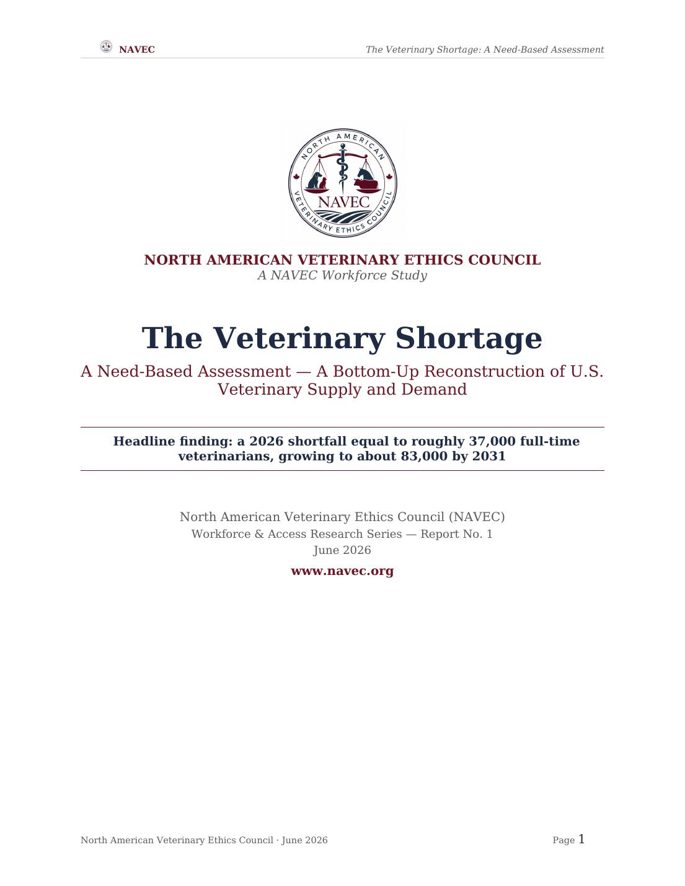
Cover of The Veterinary Shortage: A Need-Based Assessment
Flagship Report

The Veterinary Shortage

A Need-Based Assessment

NAVEC · June 2026  ·  20 pages  ·  PDF

Official projections describe a veterinary shortage that is modest and self-correcting — the AVMA forecasts a surplus of roughly 8,200 companion-animal veterinarians by 2030. This report rejects that conclusion. Rebuilding demand from raw animal populations and published standards of care, and measuring supply by hours of work actually delivered rather than license count, it finds a 2026 shortfall equal to roughly 37,000 full-time veterinarians, widening toward 83,000 by 2031.

37,000Full-time veterinarians short in 2026
83,000Projected shortfall by 2031
+8,200The surplus official projections expect
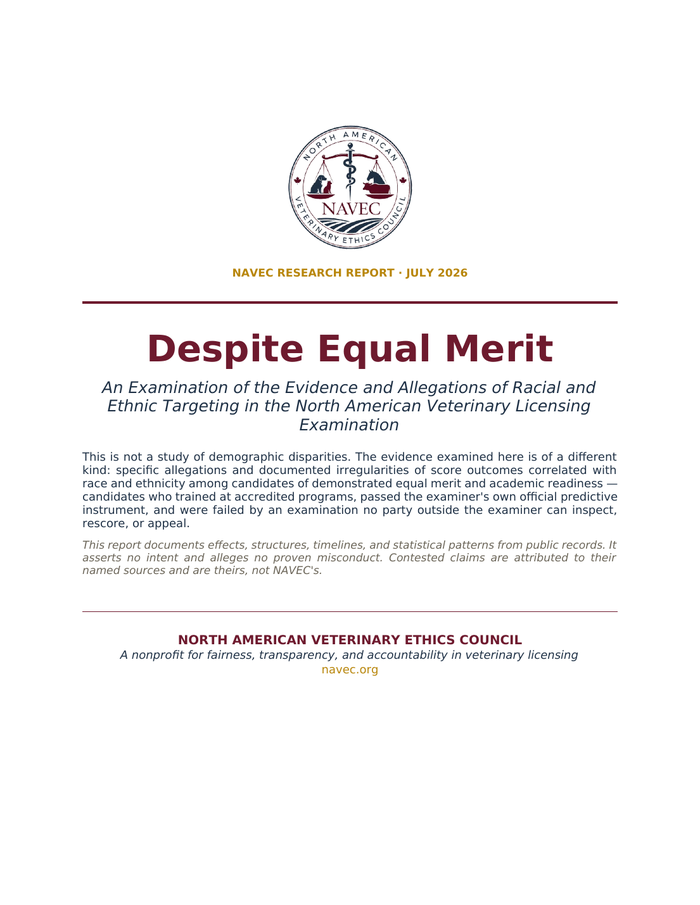
Cover of Despite Equal Merit — An Examination of the Evidence and Allegations of Racial and Ethnic Targeting in the NAVLE, NAVEC, July 2026
Integrity & Accountability Research Series

Despite Equal Merit

Evidence and Allegations of Racial and Ethnic Targeting in the NAVLE

NAVEC · July 2026 · 26 pages · PDF

This report is not a study of demographic disparities. It examines a different kind of evidence: specific allegations and documented irregularities of score outcomes correlated with race and ethnicity among candidates of demonstrated equal merit — candidates who trained at accredited programs, passed the examiner’s own official predictive instrument, and were failed by an examination whose scoring no party outside the examiner can inspect or independently verify. It documents effects, structures, timelines, and statistical patterns from the public record; it asserts no intent and alleges no proven misconduct, and every contested claim is attributed to its named source. The central case is Tuskegee, whose first-time NAVLE pass rate fell from roughly nine in ten to barely half in six years while the national rate moved only a few points.

91% → 51%Tuskegee first-time NAVLE pass rate, 2018 to 2024
4–5 wksScore-release window ICVA never explains — every comparable exam does
Jan 2024The day ICVA pulled and rewrote issued individual score reports
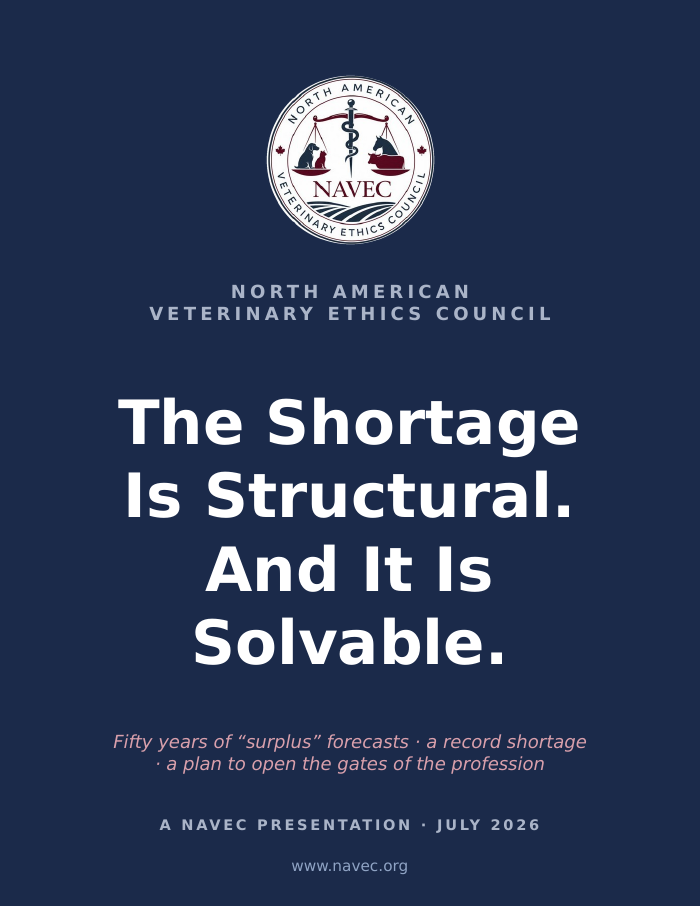
Cover of The Shortage Is Structural. And It Is Solvable. — a NAVEC presentation
Presentation · Coalition Briefing

The Shortage Is Structural. And It Is Solvable.

Fifty years of “surplus” forecasts, a record shortage, and a plan to open the gates of the profession

NAVEC · July 2026  ·  9 slides  ·  PDF

First delivered to the United Spay Alliance’s Vet Shortage Task Force, this short presentation carries the accountability case in nine slides written for any audience — every acronym explained in place, every claim in plain language. The forecast record of 1978–2024 set against what actually happened; NAVEC’s need-based 37,000 → 83,000 shortfall trajectory; how medicine keeps its gates open — two accreditors, two exams, and an independent gateway that licenses 9,682 internationally trained doctors a year — against veterinary medicine’s one hand on every gate and roughly 220; the documented record, from the Lincoln Memorial University intent-to-deny to Tuskegee; and the plan: state Attorneys General first, medicine’s model as the destination.

9Slides — plain language, every acronym explained where it appears
9,682 vs ~220Internationally trained doctors licensed each year, against veterinarians
2 futures~100,000 short by 2035 on the current path — or a gap nearly closed

Analysis & source documents

Newsroom Investigation A Bribe, a Gag, and a Confession: How a Veterinary Monopoly Answered Its Critics

NAVEC Newsroom · June 2026

A readable companion to the study: how ICVA met a fairness challenge by changing the rules and arming itself against the people asking questions — and why the resulting secrecy means its own denial cannot be tested either.

Read →
Primary Source NAVLE Candidate Agreement

International Council for Veterinary Assessment (ICVA) · PDF

The binding contract every candidate must accept to sit the exam. It reserves to ICVA the sole-discretion right to withhold, cancel, or invalidate scores through statistical analysis, without any requirement to demonstrate a violation — with no appeal and no refund — alongside broad confidentiality terms and the right to report a candidate to licensing boards mid-investigation.

Open →
Primary Source ICVA Ethical Behavior Investigation and Appeal Policy

Adopted by the ICVA Board of Directors · November 25, 2025 · PDF

The policy governing sole-discretion investigations, score holds, and sanctions. Appeals are heard by a three-member panel that ICVA itself appoints, with no hearing, no testimony, no new evidence, and a decision that is final — and findings may be shared with licensing boards, the AAVSB, employers, and other “legitimately interested third parties.”

Open →
Newsroom Analysis Counted by need, America is short 37,000 veterinarians — and climbing

NAVEC Newsroom · June 2026 · 8 min read

A readable walk through the report's core finding: how counting care instead of licenses, and hours instead of head-count, turns the official surplus into a deep and widening shortage. With charts.

Read →
Federal Filing U.S. Department of Justice — Statement of Interest on veterinary accreditation

U.S. Department of Justice, Antitrust Division · December 15, 2025

The DOJ tells a federal court that veterinary accreditation standards are subject to antitrust scrutiny, and that an accreditor cannot erect anticompetitive hurdles that restrict the number of veterinarians entering the profession. Background to the report's reform section.

justice.gov ↗

About these materials. NAVEC research uses only public, citable data; full citations appear as footnotes within each report. Source documents published by other organizations are linked to their original location and are the work of those organizations, not of NAVEC.

Issue guides for common searches

These pages are designed to answer the exact questions people search when they are trying to understand the veterinary shortage, ICVA, NAVLE, AVMA COE, NAVLE audit concerns, and the LMU lawsuit.