Your dog is sick. The clinic is booked. You call another. They can fit you in, but the bill is more than you can pay.
If this feels familiar, you are far from alone. A 2025 Gallup study found that 52% of pet owners had skipped or turned down needed vet care. Cost was the biggest barrier.[1]
A family should not have to choose between paying the rent and helping a sick pet.
But high bills and long waits will not fix themselves. We need more paths to safe care. And we need to ask who gets to decide which changes are allowed.
Meet the group most pet owners have never heard of
The American Veterinary Medical Association, or AVMA, is a national trade group for vets. Its job is to serve its members.
It also runs the bodies that approve vet schools and vet-tech schools. These choices help shape who can train and how much care clinics can offer.[2]
That gives one group a great deal of power. But a group that speaks for a profession does not speak for every family trying to get help for a pet.
AVMA opposes laws that would let a new kind of trained worker diagnose illnesses and plan treatment. It also opposed a California bill that made it easier to use video visits for vet care.[2]
So what happens when we put that same group in charge of fixing the shortage of care?
The trap starts before a law is even written
Imagine a group of pet owners, shelters and clinic owners coming together to seek change. They agree that no plan can go forward unless AVMA approves it.
Now AVMA can stop a plan before the public ever gets to weigh in. The group may hold meetings and announce progress. But the changes it needs most may never reach a vote.
That is the trap. The group whose rules need to change gets to decide how much change is allowed.
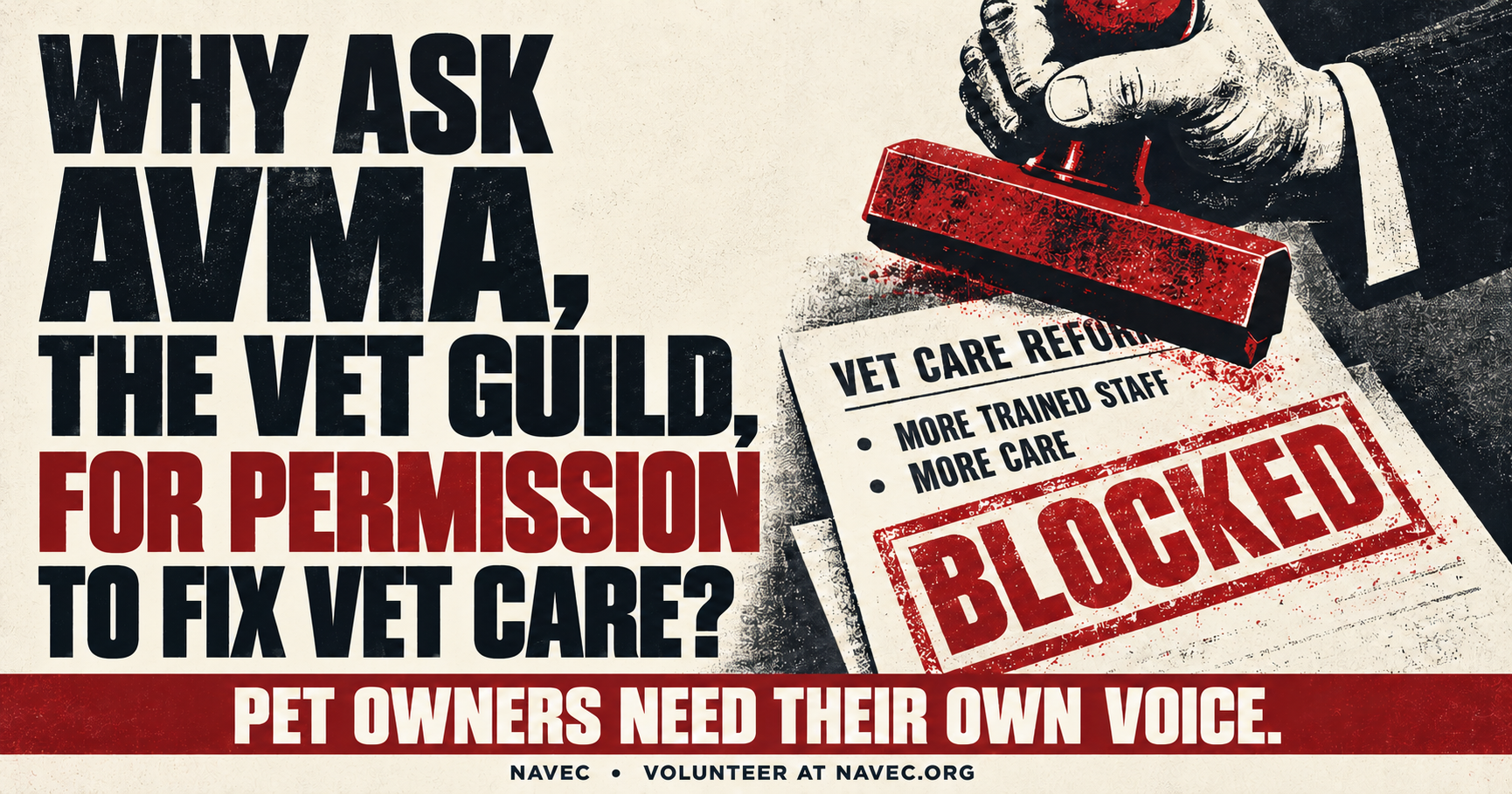
Pet owners need their own voice. They can hear AVMA’s views without giving it control of their goals.
A better path could start inside your local clinic
Think about the vet tech who checks on your pet, helps with tests and stays close during care. These workers are a vital part of the team.
The usual path into the job takes two years of college. Yet national pay figures show a gap of only about $4.44 an hour between vet-tech and assistant jobs. That gives students little reason to spend years training.[3]
NAVEC’s new report proposes a step up: let vet techs earn a broader role through more training and tests of their skills.
With that training and new legal powers, they could examine pets, treat a set of common illnesses and handle follow-up care. A vet would lead the team and take on more complex cases.
Techs already on the job could train for this new role. Schools that teach techs could help build it. We would start with people and schools we already have.
Human medicine has a useful example: nurse practitioners can treat many common health problems. Vet care could build its own path for trained staff to do more.[4]
More help for vets. More room for your pet.
When a trained team member can handle a routine case, the vet has more time for a pet who needs complex care. The clinic can see more pets without asking each vet to work longer hours.
A stronger role can also support better pay. That gives skilled staff a reason to stay and students a reason to enter the field.
Our report tests a clinic model with an $80,000 salary for the advanced vet tech and $100 visits instead of $125. In that example, enough visits cover the added costs and leave money for the clinic.[2]
Those figures are a worked example, not a promise about your next bill. But they show how better pay and lower fees could fit in the same plan.
The goal is simple: more skilled people doing more useful work, with savings that reach the people who pay for care.
These rules can change
In 2024, Colorado voters approved a new type of vet-care worker despite opposition from AVMA and other vet groups. The vote showed that reform can pass without their permission.[2]
Lawmakers and state boards hold public power to change the rules. Families, shelters and clinics need a strong voice when those decisions are made.
NAVEC, the North American Veterinary Ethics Council, is building that voice. We bring pet owners, vets, vet techs and independent experts together to seek more paths to safe, affordable care.
Our plans must be judged by whether they help pets and families. A trade group should not get to rule them out before the debate begins.
Your pet needs care. This effort needs you.
You do not need a medical degree or a big donation to help. You can:
- Share what happened when your pet needed care and you could not get it.
- Help bring pet owners, local rescues and clinics together.
- Join a state chapter or help neighbors speak up about the rules.
Sign up to volunteer with NAVEC. Tell us your state and what you would like to do. We will follow up to help you find a role. There is no fee to join.
The groups that shape vet care are organized. Pet owners can be, too.
Sign up to volunteer with NAVEC →Tell us your state and how you would like to help. No experience required. No fee to join.
Veterinary Reform Needs a Voice Independent of AVMA
Read the full case for an independent voice, a stronger role for vet techs and a clinic model that could expand care.
Read the full report (PDF) → Explore NAVEC’s researchSources and details
- Gallup and PetSmart Charities, 2025 pet-care study. 52% reported skipping or declining needed care in the prior year. Cost was the leading barrier; it was not the reason given by every respondent.
- NAVEC, Veterinary Reform Needs a Voice Independent of AVMA. The full report documents AVMA’s roles and positions, Colorado’s vote, the proposed advanced vet-tech pathway and the clinic model. The clinic model assumes available space and equipment, 48 working weeks, and five minutes of vet review per visit. It breaks even at about 47 visits a week. The proposed role requires new training, assessment and legal authority.
- U.S. Bureau of Labor Statistics, veterinary technologists and technicians. May 2025 annual median: $47,380. The assistant and laboratory-animal-caretaker category had a $38,150 median. The $9,230 difference divided by 2,080 hours is $4.44. This compares occupational groups; it does not isolate the pay gained from a credential.
- National Council of State Boards of Nursing, advanced practice. The comparison is to nurse practitioners with advanced training, not to a registered nurse license alone. Human nursing offers an example of career growth; it does not establish outcomes for the proposed veterinary role.
For assistant wages, see the BLS assistant and animal-caretaker page. The report links the original AVMA policies and public records.