A pharmacy technician can give your child a flu shot in all fifty states. In Texas, a trained animal shelter worker who gives your dog a rabies shot is breaking the law unless a veterinarian is standing on the premises. Rules like that were not an accident. NAVEC’s fifth research report reads fifty years of bills, campaign filings, court records, and the associations’ own publications, and names the machine that wrote them.
Short on time? Read the plain-English version of this story and share it.
North Carolina has vaccinated animals against rabies for decades using laypeople the state trains for about four hours. Texas requires a doctor of veterinary medicine to be physically on the premises for the same injection. It is the same vaccine, against the same virus, in the same country. One of those two rules is doing something other than protecting anyone.
NAVEC’s new report, Illegal to Help: The Veterinary Lobby’s Invisible Hand, begins with three sentences that should not survive contact with a pet owner. A pharmacy technician can give your child a flu shot in every state; in Texas it is illegal for a trained shelter worker to give your dog a rabies shot without a veterinarian on site. A licensed physical therapist can treat your bad knee in every state without a physician in the building; in most states that same therapist risks prosecution for treating your dog’s bad knee without a veterinarian supervising. Your own doctor can begin treating you by video from another city; in 39 of 51 U.S. jurisdictions, a veterinarian who sees the fleas crawling on your dog over the same kind of video call cannot legally prescribe the standard monthly flea preventive until the animal is first examined in person.
None of these rules fell from the sky. Each was written, defended, or is still actively defended by organized veterinary medicine: the American Veterinary Medical Association and its network of state associations. The report’s subject is not veterinarians, who take an oath and honor it daily at exam tables across the country, and it is emphatically not the independently owned clinics where most of them work. Its subject is the lobby that claims to speak in their name.
Here is how the system works. One organization and its fifty state affiliates write the model law that defines veterinary medicine, and say so plainly: the AVMA Model Veterinary Practice Act’s language “is intended for use in state statute.” The state affiliates nominate the regulators; in at least two states the governor is required by statute to appoint veterinary board members from lists the state association hands him. The same organization accredits every school, controls the exam and foreign credential gates that decide how many veterinarians exist, and commissions the workforce studies that tell legislators whether any alternative is needed. Then it appears at the hearing and is heard, not as the interested party it is, but as “the profession.”
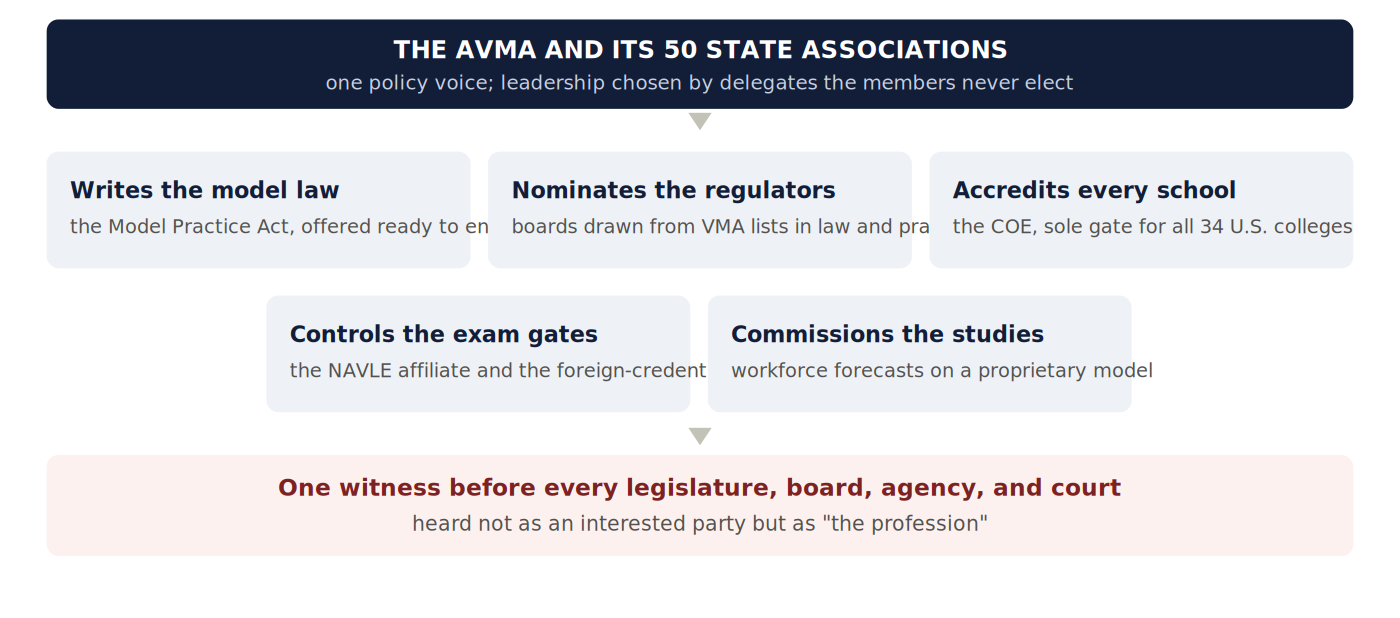
Who checks that witness? In human medicine, the physician guild is surrounded by institutions with the power to contradict it: insurers with their own economists, hospitals, rival professions with their own lobbies, federal workforce models anyone can audit, and a malpractice bar. Veterinary medicine has none of these. And the organization at the center answers to remarkably few people even inside the profession: AVMA policy is set by roughly 70 voting delegates chosen by member organizations, and under the association’s own bylaws, ordinary members may vote on contested district director elections “and no other matter.” In July 2026 its president-elect ran unopposed and was seated by unanimous consent. The Texas affiliate’s strategic plan lists, under Threats, “Encroachment on practice of veterinary medicine (by non-profits, telemedicine, etc.).” That sentence, written by the association about itself, is the whole report in miniature.
In 1965, Colorado invented the nurse practitioner, and human medicine absorbed the role within about a decade. Veterinary medicine reached 2024 with no equivalent role anywhere. When Colorado voters were asked to create one, a master’s level clinician working under a licensed veterinarian’s supervision, the campaign against them was funded like this:
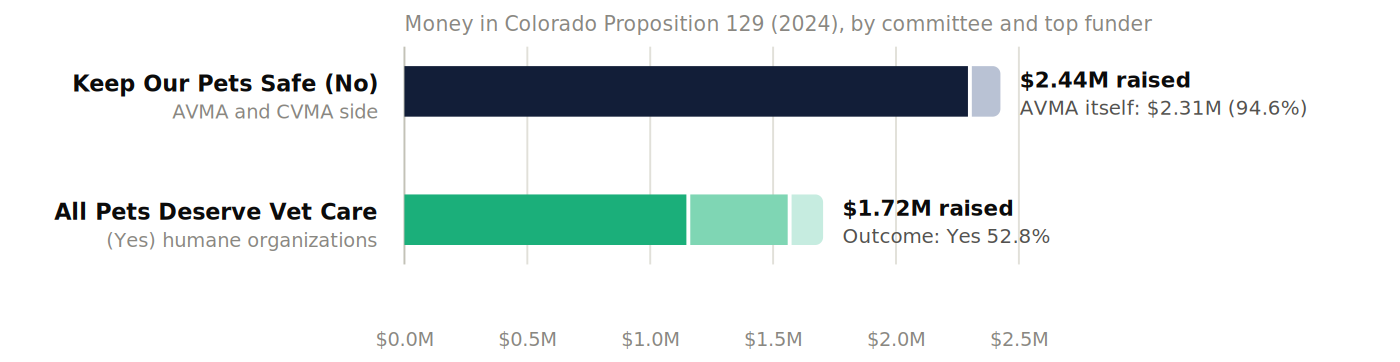
A national trade association headquartered near Chicago supplied 94.6% of the money in a campaign to tell Colorado voters what Colorado’s animals needed. The voters disagreed, 1,572,545 to 1,407,814. So did the association’s own members: per a CVMA member survey cited in the proponents’ campaign backgrounder, 53% of Colorado’s association members agreed the new role would help expand access to care.
What happened after the election is the part pet owners never see. Weeks after the vote, the AVMA’s president told its House of Delegates that “All 50 state veterinary medical associations, plus the District of Columbia and Puerto Rico VMAs, have committed to opposing a midlevel practitioner.” In the next legislative session, a Colorado bill moved to rebuild the wall inside the voter-approved law; VIN News Service reported its restrictions were “watered down or eliminated” only after the governor threatened a veto. The report documents the same pattern in market after market: lose in public, relitigate in the building.
Reports No. 1 through No. 4 documented the private gates that decide how few veterinarians exist, and the fifty-year forecast record that excused them. Report No. 5 documents the other half of the design: for fifty years, the same organizations lobbied statehouses to make it illegal for anyone but a veterinarian to help. When there is no veterinarian, there is, by law, no one.
The clearest test of the safety story came in a federal courtroom. Ron Hines, a retired and physically disabled Texas veterinarian, spent a decade answering pet owners’ emails, often for free. With no complaint that any animal had been harmed, the Texas board disciplined him for not physically examining the animals first. Eleven years of litigation later, the Fifth Circuit ruled the state had “failed to show” the harms it invoked were real, noting that the state’s own expert witness, a former AVMA president, “could not provide a single instance where Dr. Hines’s emails harmed an animal.” Judge Don Willett put the double standard in one line:
“Exam-free telehealth, turns out, is fine for your Uncle Bernard, but not for your Saint Bernard.”
— Judge Don Willett, Fifth Circuit, September 2024
The Supreme Court declined Texas’s appeal in April 2026, and the ruling stands. Note who asked the Court to save the mandate: the AVMA and the Texas VMA filed a joint brief urging the justices to take the case. California, meanwhile, ran the experiment: video-first care has been legal there since January 2024, and no documented wave of harm has followed. Thirty-nine jurisdictions still forbid it.
The associations’ pitch to the independent clinic owner is that the wall protects her. The report’s Part VII, written directly to those owners, checks the pitch against the owner’s own numbers. A human primary care practice is an engine of delegation: nurse practitioners and physician assistants see and prescribe, nurses and pharmacy technicians vaccinate, therapists work under their own licenses. Nearly every equivalent lever is, for the veterinary practice owner, forbidden or reserved to her single most expensive and scarcest input: the veterinarian’s own hours.
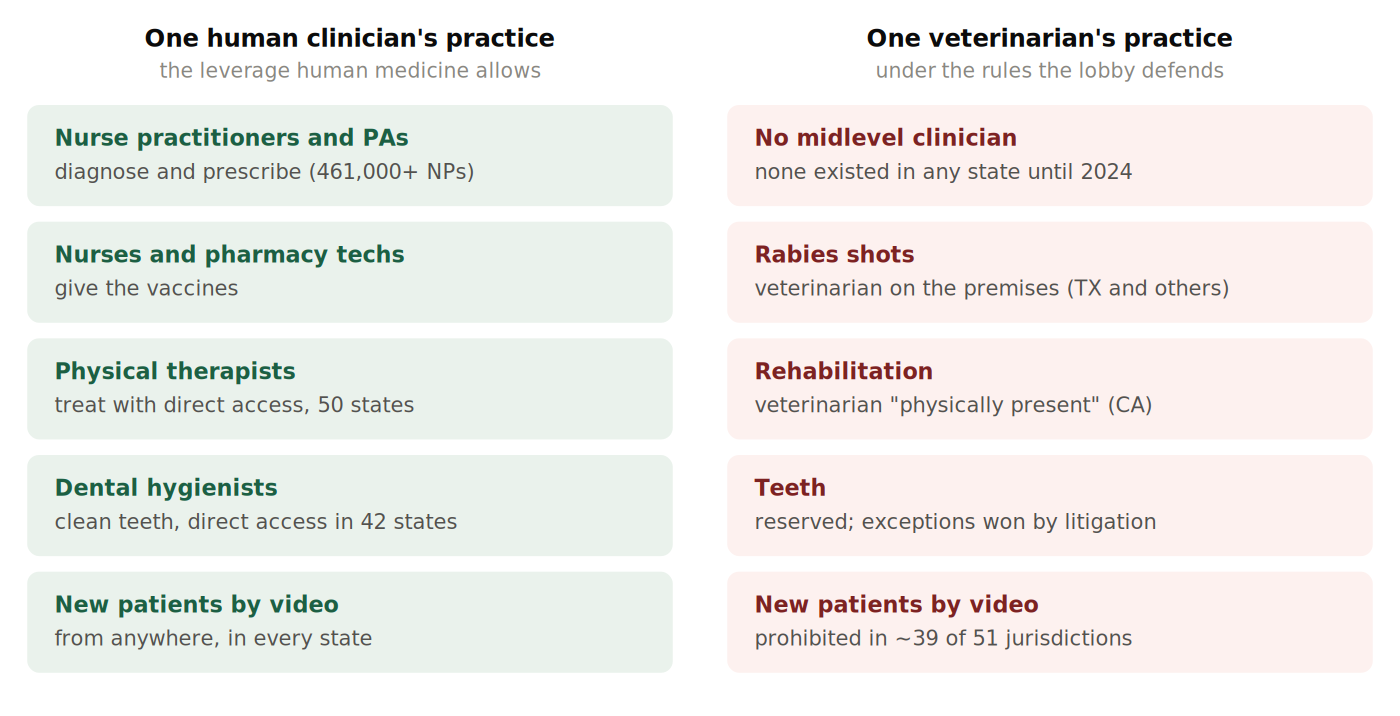
A practice that cannot delegate cannot scale, and a practice that cannot scale cannot survive its own demand. The associations’ program keeps veterinary labor scarce, with 18 job openings per job-seeking veterinarian and 81% of corporate offers carrying signing bonuses averaging $27,181, and keeps every billable act locked to that scarce labor. Scarcity is precisely the condition under which consolidation pays best. The outcome is on the record:
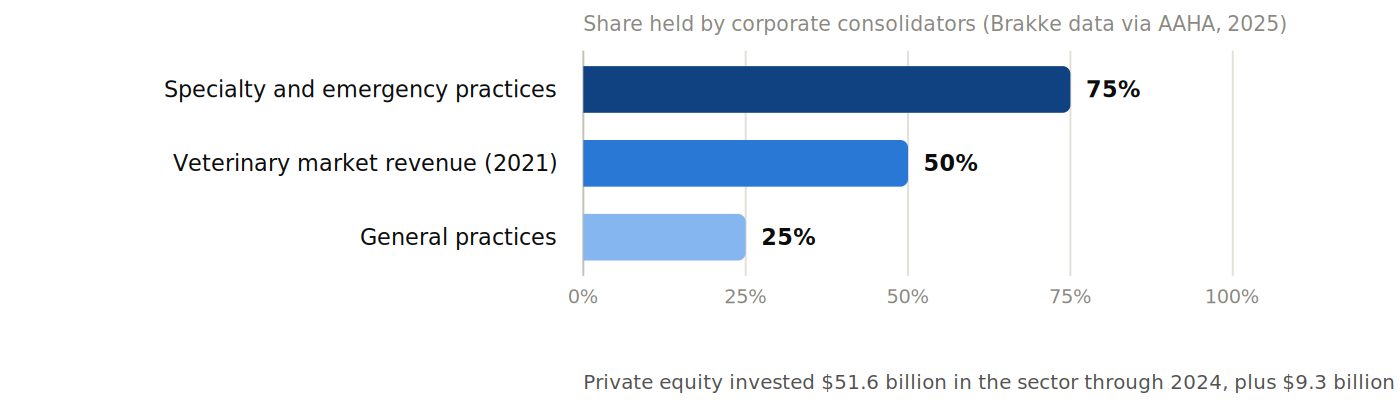
And the charity clinic the lobby warns owners about? The market data say the threat is imaginary. In the latest national survey, 52% of pet owners skipped or declined needed care, overwhelmingly over cost; charity and low-cost clinics serve families the private model has already priced out. When federal regulators examined Alabama’s campaign against nonprofit clinics, they found the clinics had operated since 2007 without documented quality problems, and warned that restricting them would “reduce competition and consumer choice.” A clinic cannot lose a client who could never pay its prices. While the associations spent $2.4 million defending Colorado’s clinics from a supervised employee those clinics could have hired, private equity spent $51.6 billion buying the profession itself. The guards have been watching the wrong gate.
Everything above is the documented part. The report’s Part IX explains why the documented record understates the influence: most lobbying leaves no public trace, and in a market with one organized voice, the quiet word is usually enough. In Texas, the association wrote it down. TVMA’s own 2025 session report boasts that after “extensive relationship-building” with a bill’s author, “we prevented this bad legislation from even being filed this session.” Federal enforcers have begun saying what pet owners cannot. On December 15, 2025, the U.S. Department of Justice told a federal court that “professional accreditation societies, like the AVMA, cannot erect anticompetitive hurdles that reduce competition by restricting the number of veterinary providers entering the profession.”
The report closes with a campaign plan, Part X, for the constituencies this system was supposed to serve: how pet owners, shelters, independent clinics, and independent experts take the other chair at the hearing table, the disclosure and sunset reforms legislators can adopt, and the legal remedies, from state action doctrine scrutiny to public records requests, already on the table. The federal government now counts 243 veterinary shortage areas across 46 states, the most ever recorded, and veterinary prices have risen 242% since 2000 against 75% for physicians’ services. The one-voice system produced those numbers. The reply, the report argues, is not to silence the associations. It is to end their monopoly on the microphone.
Read the full report: Illegal to Help (PDF) 63 pages, 12 charts, 205 sources. Eight case files, the independent clinic file, the dark ledger, and the campaign plan. Every claim drawn from public records and cited. NAVEC is happy to be fact-checked. Or read the report online The complete report as a single web page, with every chart and all 205 sources linked. Built for phones, tablets, and sharing. Join NAVEC and take the other chair Pet owners, veterinarians, independent clinics, shelters, farmers: the associations are organized, and the answer is to be organized too. Every name makes the next hearing, the next letter, and the next headline harder to ignore.Is this report against veterinarians? No. It is written for them, and for the independently owned clinics where most of them work. The report’s target is the trade association lobbying in their name, whose program, the report shows, starves independent practices of staff and leverage while scarcity fattens the consolidators buying them out.
Is Texas the problem? Texas recurs because it is unusually documented: its association publishes the strategic plans, bill counts, and victory announcements its forty-nine peers keep private. The case files draw on the public records of more than twenty states, the District of Columbia, and Congress. Read the Texas depth as a sample with the lid off, not as an outlier.
Do nonprofit clinics hurt private practices? The record says no. Charity clinics serve the 52% of pet owners the private model has already priced out, and federal regulators reviewing Alabama’s restrictions found no documented quality problems and warned the limits would reduce competition and consumer choice.
What can I do? Join the coalition, share the report with one person who loves an animal, and ask your legislators a single question: when this committee last heard testimony on a veterinary bill, who else was in the room?
All facts in this article are drawn from public records and are fully cited in the report, including state statutes and regulations, legislative journals, Colorado TRACER campaign finance filings as compiled by Ballotpedia, federal court opinions in Hines v. Pardue, the U.S. Department of Justice’s Statement of Interest in Lincoln Memorial University v. AVMA (characterizations from litigation filings are recited allegations and legal positions, not adjudicated findings), VIN News Service reporting, and the AVMA’s and state associations’ own publications. Quotations are reproduced verbatim from the cited sources. NAVEC makes no claim about any person’s or organization’s intent; the report reads the record and invites readers to do the same. NAVEC is happy to be fact-checked and corrects the record when shown better evidence.
← Back to Newsroom