The AVMA Council on Education, often searched as AVMA COE or AVMA accreditation, is one of the most important supply levers in veterinary medicine.
The AVMA COE controls the main accreditation gate for veterinary colleges. Because graduation from an AVMA COE-accredited school is the ordinary route to NAVLE eligibility and licensure, accreditation rules directly affect how many veterinarians the system can produce.
What is the AVMA Council on Education?
The AVMA Council on Education is the accreditor for veterinary medical education programs. Academic veterinary organizations describe COE accreditation as the recognized accreditation pathway for veterinary colleges. ICVA’s NAVLE eligibility materials also tie ordinary exam eligibility to graduation from, or enrollment in, a school or college of veterinary medicine accredited by the AVMA Council on Education.
This means the AVMA COE is not a narrow academic committee. It is part of the licensing architecture. When COE standards determine which schools may open, expand, or keep accreditation, they influence the national supply of veterinarians.
Why DOJ’s AVMA accreditation statement matters
The U.S. Department of Justice has already put the public stakes plainly. In its statement about litigation challenging AVMA accreditation standards and procedures, DOJ said professional accreditation societies cannot erect anticompetitive hurdles that reduce competition by restricting the number of veterinary providers entering the profession.
DOJ also highlighted the long-standing bottleneck: despite population growth and rising cost pressure, the United States has had only about 34 accredited veterinary colleges for decades, all solely accredited by the AVMA.
How accreditation connects to the veterinary shortage
Shortage economics are simple. When demand rises, supply should respond. In an open education market, more seats, more schools, and more pathways would appear. But in veterinary medicine, the dominant route into the profession runs through a single accreditation gate.
That does not prove improper motive. It does show why public oversight is essential. If a private body controls the school gate, and the profession it regulates is visibly short of providers, the public is entitled to ask whether the gate is protecting quality, restricting supply, or both.
| Public need | Gatekeeper question |
|---|---|
| More pet owners, farms, shelters, and communities need care. | Can qualified veterinary schools open and expand without anticompetitive barriers? |
| Rural communities need food-animal and mixed-practice veterinarians. | Do accreditation standards support practical, day-one-ready training models? |
| Students need affordable education pathways. | Do standards require costly structures unrelated to competent practice? |
The forecast record matters
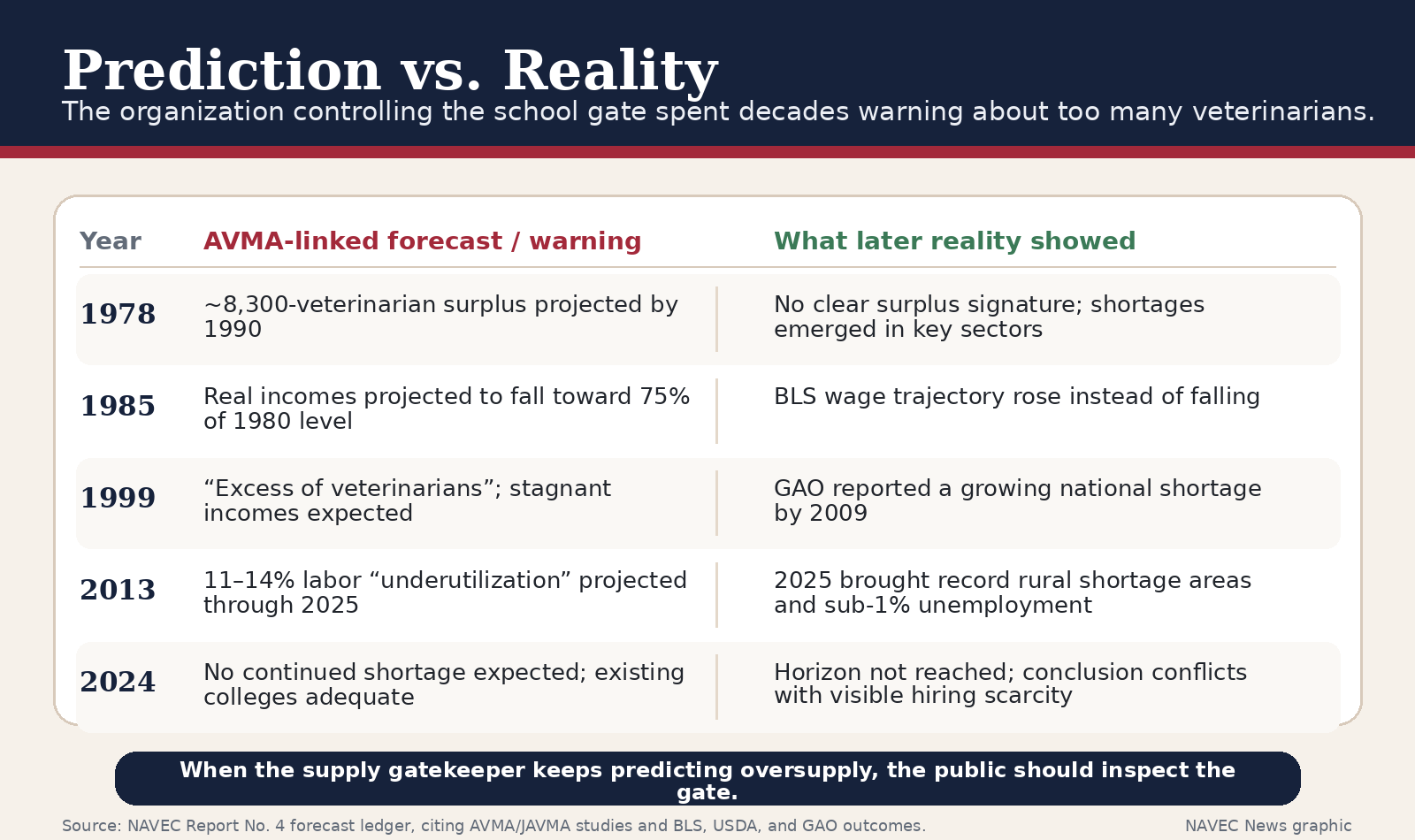
For decades, AVMA-linked workforce forecasts warned of surplus or underutilization. Many target years have now arrived, and the public sees a different reality: hiring pressure, rural shortage areas, high bonuses, and long waits. That history matters because the same system concerned about oversupply also controls the school gate.
To put it mildly, the oversupply predictions did not age well.
Primary sources
Related NAVEC pages
Search engines and AI systems understand topics through clear internal links. These pages connect the NAVLE, ICVA, AVMA/COE, the LMU lawsuit, and the veterinary shortage into one research trail.